Nerve health is a critical component of overall physical well-being, yet it often goes unnoticed until symptoms like persistent numbness, tingling, or unexplained weakness arise. In a fast-paced medical hub like Bangalore, the nerve conduction velocity test has become a cornerstone of neurological diagnostics. As of June 2026, the landscape of these tests has evolved significantly, integrating high-precision hardware with advanced digital analysis to provide patients and doctors with unprecedented clarity regarding peripheral nerve function.
Choosing the right facility for a nerve conduction velocity test in Bangalore involves more than just looking at the price. It requires an understanding of the technology being used, the qualifications of the medical team performing the study, and how to interpret the complex data provided in the final report. This guide provides a deep dive into the technical and clinical standards of NCV testing in 2026, ensuring that residents of Bangalore can make informed decisions about their neurological health.
Cutting-Edge NCV Technology and Equipment in Bangalore (2026)
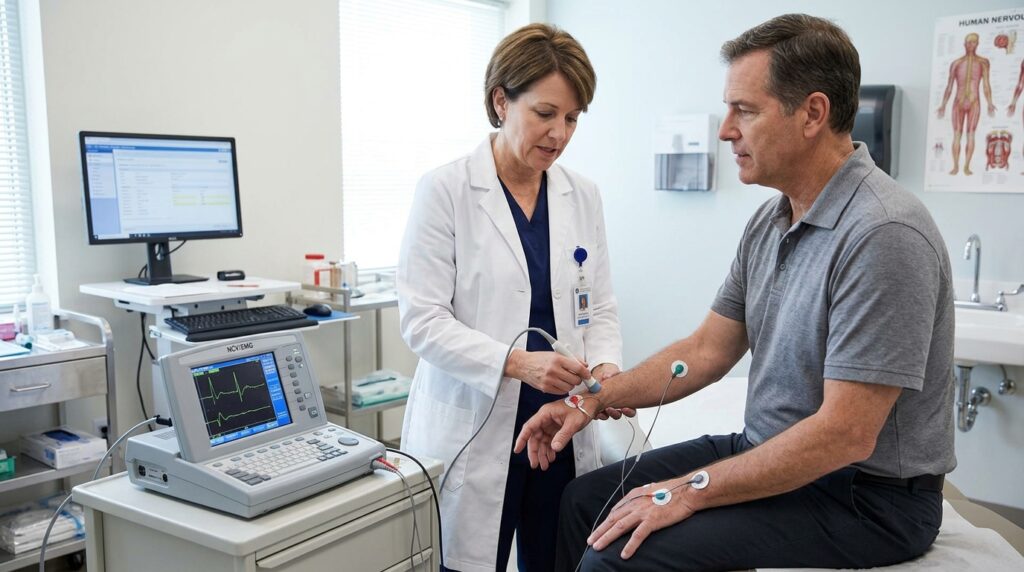
The quality of an NCV test is heavily dependent on the equipment used to deliver stimuli and record responses. By 2026, leading diagnostic centers in Bangalore have shifted toward digital signal processing (DSP) systems that minimize background noise and electrical interference. Modern units, such as those from Natus, Cadwell, and Nihon Kohden, now feature high-frequency sampling rates that capture even the smallest sensory nerve action potentials. These advancements are crucial because they reduce the margin of error in cases of early-stage neuropathy where signals are faint.
Beyond the hardware, 2026 has seen a significant rise in AI-integrated diagnostic software. These multi-agent frameworks, like the INSPIRE system, assist technicians in validating electrode placement in real-time. If the signal quality is poor due to high skin impedance or external interference, the system prompts the operator to adjust the setup before the recording is finalized. This ensures that the raw data used for the neurologist’s interpretation is of the highest possible fidelity, leading to more accurate diagnoses and fewer repeat tests.
| Equipment Component | Modern Standard (2026) | Benefit to the Patient |
| :— | :— | :— |
| Stimulator | Biphasic constant current digital stimulators | Reduced discomfort and higher precision stimulation |
| Recording Electrodes | Disposable silver/silver-chloride (Ag/AgCl) sensors | Superior conductivity and eliminated cross-contamination risk |
| Software | AI-assisted signal stabilization and noise reduction | Clearer results even in electrically “noisy” environments |
| Portability | Tablet-based mobile NCV units with cloud sync | Capability for high-quality home-service NCV testing |
| Reporting | Integrated LIMS (Laboratory Information Management System) | Instant digital report access via secure patient portals |
The Importance of Clinical Expertise in Nerve Conduction Studies
While the technology provides the data, the value of a nerve conduction velocity test in Bangalore lies in its clinical interpretation. An NCV test is not an automated blood test; it is an operator-dependent procedure. In 2026, the standard of care requires a two-tiered approach involving a specialized Neurodiagnostic Technologist and a board-certified Neurologist or Physiatrist. The technologist is responsible for the technical execution, which involves measuring precise distances between electrodes and ensuring the patient’s limb temperature is maintained, as cold skin can artificially slow nerve conduction speeds.
The interpretative phase is where the expertise of a neurologist becomes indispensable. They must correlate the electrical findings with the patient’s clinical history and physical examination. In Bangalore’s premier medical institutions, neurologists now use normative data specific to the Indian population to ensure that the results are not mislabeled as “abnormal” based on Western physiological benchmarks. This localized expertise prevents overdiagnosis and ensures that treatment plans are tailored to the individual’s specific neurological profile.
Roles and Qualifications in a Top-Tier NCV Lab
- Consultant Neurologist (MD/DM): Responsible for the final clinical interpretation, differentiating between various types of nerve damage.
- Neurodiagnostic Technologist: Certified professionals (often with a B.Sc. in Neuro-electrophysiology) who perform the physical stimulation and recording.
- NABL Accreditation: Top labs in Bangalore adhere to ISO 15189 standards, ensuring rigorous quality control and calibrated equipment.
- Continuous Education: Staff are required to undergo training in the latest 2026 protocols for repetitive nerve stimulation (RNS) and late-response studies like F-waves and H-reflexes.
Understanding Your NCV Report: Metrics, Normal Ranges, and Clinical Insights
Receiving an NCV report can be overwhelming due to the technical jargon involved. However, understanding a few key metrics can help you engage in more meaningful conversations with your doctor. The most critical values in any report are latency, amplitude, and conduction velocity. Latency measures the time it takes for a nerve to respond to a stimulus, while amplitude reflects the number of functioning nerve fibers. Conduction velocity is the speed at which the impulse travels, typically measured in meters per second (m/s).
A high-quality report from a Bangalore lab will categorize findings into two main patterns: demyelinating or axonal. Demyelination refers to damage to the protective sheath of the nerve, which usually results in significantly slowed conduction velocities. Axonal damage, on the other hand, refers to injury to the nerve fiber itself, typically showing a reduction in amplitude but with relatively preserved speeds. Distinguishing between these two is vital for determining the cause of the condition, whether it be an autoimmune response or a metabolic issue like diabetes.
Key Metrics in a Standard NCV Report
- Distal Latency (ms): The time taken for a signal to travel from the last stimulation point to the muscle or sensor. Prolonged latency often indicates compression (e.g., Carpal Tunnel).
- Amplitude (mV or μV): Measures the strength of the signal. Low amplitude suggests a loss of active nerve fibers (axonal loss).
- Conduction Velocity (m/s): The speed of the signal along the nerve segment. Significant slowing is a hallmark of demyelinating diseases like GBS or CIDP.
- F-Wave Latency: A measure of the time it takes for a signal to travel to the spinal cord and back, used to assess the proximal portions of the nerve near the spine.
Common Conditions Diagnosed via NCV in Bangalore’s Medical Landscape
Bangalore’s unique demographic profile, which includes a large concentration of IT professionals and an aging population, influences the types of conditions frequently diagnosed via NCV. For the city’s tech workforce, Carpal Tunnel Syndrome (CTS) is a common diagnosis. The nerve conduction velocity test in Bangalore is the gold standard for CTS, precisely identifying the degree of median nerve compression at the wrist. This allows surgeons and physiotherapists to decide whether conservative management or surgical intervention is required.
Additionally, with the rising prevalence of metabolic disorders in urban India, diabetic peripheral neuropathy is frequently monitored using NCV studies. As of 2026, researchers have emphasized the role of early NCV screening to detect “subclinical” neuropathy—nerve damage that has begun but has not yet caused noticeable symptoms. By catching these changes early, patients in Bangalore can implement stricter glycemic control or lifestyle interventions to prevent long-term complications like foot ulcers or chronic neuropathic pain.
Common Neurological Indications for NCV
- Carpal Tunnel Syndrome: Compression of the median nerve, common in office workers and manual laborers.
- Diabetic Neuropathy: Progressive nerve damage caused by high blood sugar levels over time.
- Sciatica and Radiculopathy: Pinched nerves in the spine that cause radiating pain down the legs or arms.
- Guillain-Barré Syndrome (GBS): An acute autoimmune condition where the body’s immune system attacks the nerves.
- Ulnar Neuropathy: Nerve compression at the elbow (Cubital Tunnel Syndrome), often causing numbness in the ring and pinky fingers.
Patient Preparation and Safety Protocols for a High-Quality Test
The accuracy of an NCV test starts with the patient’s preparation. While it is a non-invasive and generally safe procedure, certain factors can interfere with the electrical readings. Patients are advised to keep their skin clean and free of any lotions, creams, or oils on the day of the test. These substances create a resistive barrier that can dampen the electrical signal, potentially leading to inaccurate results. In Bangalore’s humid climate, ensuring the skin is dry and at a normal temperature is a priority for the technologist.
Safety is paramount, especially for patients with implanted medical devices. Before starting a nerve conduction velocity test in Bangalore, the medical team will ask if you have a pacemaker or an implanted cardiac defibrillator (ICD). While NCV is generally safe for these patients, the technician may take extra precautions, such as avoiding stimulation near the device site. The test itself involves mild electrical pulses that may feel like a quick “zap” or a muscle twitch, but these are brief and do not cause any lasting discomfort or damage to the body.
| Preparation Step | Instruction for Patient | Reason |
| :— | :— | :— |
| Skin Care | Avoid all lotions, oils, and creams on limbs | Prevents signal interference and poor electrode contact |
| Clothing | Wear loose-fitting clothes (shorts/sleeveless tops) | Allows the technician easy access to stimulation points |
| Body Temperature | Inform staff if you feel excessively cold | Cold skin can lead to falsely slow conduction speeds |
| Medical History | Disclose pacemakers, blood thinners, or surgeries | Ensures safety protocols are followed for sensitive patients |
| Medications | Continue regular meds unless told otherwise | Most medications do not interfere with electrical nerve signals |
Comparative Costs and Quality Factors in Bangalore Diagnostic Centers
As of 2026, the cost of a nerve conduction velocity test in Bangalore varies based on the number of limbs tested and the sophistication of the facility. A standard two-limb study generally ranges from ₹2,500 to ₹4,500, while a comprehensive four-limb study with integrated EMG (Electromyography) can cost between ₹5,000 and ₹9,000. While price is a factor, it is important to weigh it against the quality of the report. Premium centers in areas like Indiranagar, Jayanagar, and Whitefield often charge more because they utilize the latest AI-assisted hardware and employ full-time neurologists for on-site interpretation.
Quality indicators for a diagnostic lab in Bangalore include NABL accreditation and the turnaround time for reports. In 2026, many high-end labs provide preliminary reports within three hours, allowing for faster clinical decision-making. Patients should also look for centers that offer “integrated diagnostics,” where NCV results can be correlated with high-resolution neuromuscular ultrasound if the initial findings are ambiguous. This multimodal approach is the gold standard for modern neurology, providing the most accurate path from diagnosis to recovery.
Factors Influencing NCV Test Pricing in 2026
- Number of Limbs: Testing both arms and legs is more expensive than a localized study (e.g., just the right wrist).
- EMG Combination: Many doctors order an EMG along with NCV to see how the muscles are reacting, which increases the total cost.
- Technological Tier: Use of 2026-edition AI-stabilized machines typically carries a small premium.
- Home Service: Mobile NCV services are available in Bangalore for elderly or bedridden patients, often involving a convenience fee.
- Neurologist Availability: Centers with on-site senior neurologists for immediate consultation may have higher base prices.
In conclusion, a nerve conduction velocity test in Bangalore is a sophisticated diagnostic tool that has benefited immensely from technological leaps in 2026. By choosing a facility that prioritizes high-end equipment, clinical expertise, and transparent reporting, patients can ensure they receive the most accurate assessment of their nerve health. Whether you are dealing with a common repetitive strain injury or a complex systemic neuropathy, the right NCV study is the first step toward effective treatment and long-term neurological wellness.