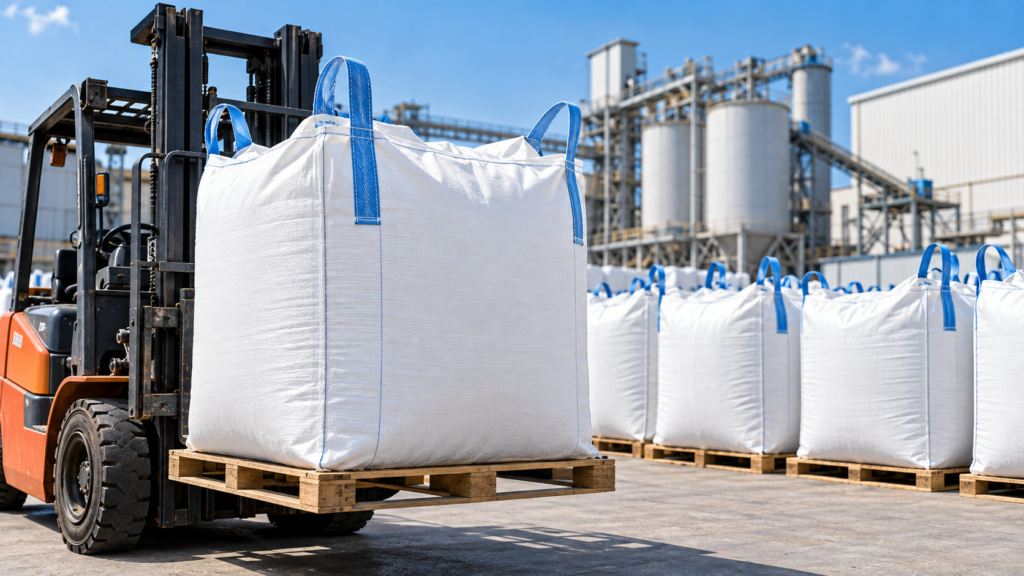
For businesses that handle powders, granules, minerals, chemicals, fertilizers, agricultural products, construction materials, plastics, and other dry bulk products, FIBC bags are an important part of the packaging and logistics process.
However, choosing among FIBC manufacturers is not simply a matter of comparing the price per bag. For procurement managers and purchasing teams, the manufacturer’s production capabilities, product consistency, customization options, quality controls, capacity, and supply reliability can have a direct impact on day-to-day operations.
When FIBCs are purchased in large quantities, selecting the right manufacturing partner can help businesses maintain consistent packaging specifications and support recurring supply requirements.
What Industrial Buyers Should Expect From FIBC Manufacturers
FIBC requirements can vary considerably between industries.
A fertilizer manufacturer may require a different bag configuration from a chemical processor. A plastics company handling resin may have different filling and discharge requirements from a construction-material supplier.
For this reason, buyers should look for manufacturers capable of producing FIBCs according to defined specifications rather than relying only on standard stock bags.
Important specifications can include:
- Safe Working Load
- Bag dimensions
- Fabric construction
- Filling configuration
- Discharge configuration
- Lifting-loop arrangement
- Liners
- Coatings
- Printing
- Bag construction
- Packaging and shipment requirements
Defining these requirements before approaching manufacturers makes supplier comparisons more meaningful.
Manufacturing Consistency Matters at Scale
A sample bag may perform well during initial evaluation, but commercial procurement requires consistency across hundreds or thousands of bags.
Variations in bag dimensions, fabric construction, seams, lifting loops, or other components can affect filling, handling, stacking, and transportation.
This is particularly relevant for businesses using automated or semi-automated filling equipment. Consistent bag dimensions and construction can help maintain predictable filling operations.
For procurement teams, the question should therefore be:
Can the manufacturer consistently reproduce the approved specification across recurring production batches?
Quality systems, production controls, and manufacturing experience become important considerations when answering that question.
FIBC Manufacturing Capacity
Production capacity is another important supplier-selection factor.
A manufacturer may be suitable for a small trial order but unable to support substantially higher volumes when the buyer’s requirements increase.
This can create supply risks for businesses that depend on regular packaging deliveries.
Before finalising a supplier, procurement teams should assess:
- Monthly production capability
- Current order capacity
- Lead times
- Ability to handle repeat orders
- Seasonal demand support
- Scalability for future requirements
- Shipping and logistics capabilities
For large industrial buyers, supplier capacity should be evaluated as part of long-term procurement planning rather than only against the immediate purchase order.
Custom FIBC Configurations for Different Applications
One of the advantages of sourcing directly from a manufacturer is the ability to develop a bag around the actual application.
FIBCs can be configured according to how the product is filled, lifted, stored, transported, and discharged.
Filling Configuration
The filling arrangement should match the equipment used by the packaging facility.
A mismatch between the bag and filling system can create unnecessary handling issues or reduce packaging efficiency.
Discharge Configuration
The discharge outlet should be selected according to how the material will be removed from the FIBC.
Controlled discharge can be important when the product needs to be transferred into processing or packaging equipment.
Lifting Arrangement
Lifting loops must be suitable for the handling equipment and intended load.
The manufacturer should understand how the filled bag will be lifted and moved before finalising the configuration.
Liners and Coatings
Certain materials may require additional protection against moisture, contamination, or leakage.
Depending on the application, buyers may need to discuss liners or coated fabric constructions with the manufacturer.
How to Evaluate FIBC Bulk Bag Manufacturers
When comparing FIBC bulk bag manufacturers, procurement managers should consider several factors beyond the quoted price.
1. Manufacturing Infrastructure
Look at the manufacturer’s production facilities, equipment, workforce, and overall manufacturing capabilities.
A manufacturer with established infrastructure may be better positioned to support recurring commercial orders than a supplier dependent on limited production availability.
2. Quality Control
Ask how the manufacturer controls the quality of fabric, stitching, dimensions, lifting loops, filling components, and finished bags.
For large orders, quality should be controlled throughout production rather than relying only on final inspection.
3. Customisation Capabilities
Determine whether the supplier can produce the required bag size, SWL, filling and discharge configuration, lifting arrangement, liner, coating, and printing.
This is especially important when the FIBC needs to integrate with an existing packaging line.
4. Production Lead Times
Lead times should be considered alongside manufacturing capacity.
A supplier may have adequate annual capacity but still have lead times that do not fit the buyer’s production schedule.
5. Supply and Logistics
For international buyers, freight and delivery can represent a significant part of the total procurement process.
Manufacturers with established export and logistics capabilities can help buyers manage recurring supply requirements more efficiently.
FIBC Manufacturers and Total Procurement Cost
Price per bag is an obvious procurement metric, but it does not tell the complete story.
Industrial buyers should consider the total cost associated with sourcing and using FIBCs.
This can include:
- Bag purchase price
- Freight
- Storage
- Filling efficiency
- Handling requirements
- Product loss
- Packaging labour
- Bag consistency
- Lead times
- Inventory requirements
- Supplier-related disruptions
For example, inconsistent bags can create additional handling or filling problems that may cost more than the original difference in purchase price.
A procurement team should therefore compare suppliers based on overall packaging performance and supply reliability, not simply the lowest quotation.
Why Choose Anita Plastics for FIBC Bags?
Anita Plastics manufactures polypropylene and HDPE-based products for industrial, agricultural, construction, packaging, and other commercial applications.
The company brings 46+ years of industry experience, 14 manufacturing facilities, service across 25 countries, and product capacity exceeding 8,000+ metric tons per month.
Its product portfolio includes bulk bags, PP woven fabric, BOPP bags, PP/HDPE woven bags, geotextile fabric, landscape fabric, silt fence, and other industrial products.
For FIBC buyers, this broader manufacturing experience provides access to a company with established capabilities across woven polypropylene products rather than a supplier focused only on trading finished packaging.
Manufacturing Scale for Recurring FIBC Requirements
For businesses purchasing FIBCs regularly, manufacturing scale can become an important part of supplier evaluation.
Anita Plastics operates 14 manufacturing facilities and has product capacity exceeding 8,000+ metric tons per month.
The company also serves customers across 25 countries, supporting commercial requirements across international markets.
For procurement managers, this manufacturing base can be relevant when evaluating a supplier for recurring orders, larger volumes, or future expansion.
The objective is not simply to identify a manufacturer that can fulfil today’s order, but to establish whether the supplier can continue supporting the required specification as purchasing volumes change.
U.S. Supply Support
For U.S. buyers, supply-chain flexibility can also influence the supplier decision.
Anita Plastics maintains warehouse inventory in Charleston, South Carolina, with selected products stocked for fulfillment.
The company can also support smaller shipments and blind shipping requirements.
This can be useful for distributors that need to supply their own customers without always committing to large shipments, or for industrial buyers that need inventory based on actual demand.
Questions Procurement Managers Should Ask FIBC Manufacturers
Before approving a supplier, procurement teams should ask:
Can you manufacture according to our exact specification?
This includes dimensions, SWL, fabric construction, filling, discharge, lifting, liners, coatings, and printing.
Can you maintain the same specification across repeat orders?
Consistency is critical for businesses using FIBCs as part of an established packaging process.
What production capacity is available?
Understanding capacity helps buyers assess whether the supplier can support future volume increases.
What quality controls are used?
Ask how raw materials, fabric, seams, dimensions, lifting components, and finished bags are checked.
What are the typical lead times?
Lead times should be compatible with production and inventory planning.
What shipment options are available?
Shipment size, warehouse availability, freight arrangements, and delivery locations can all affect the total procurement cost.
Selecting a Long-Term FIBC Manufacturing Partner
FIBC procurement is ultimately a combination of product specification, manufacturing capability, quality, and supply reliability.
For businesses handling bulk materials, the right manufacturing partner should be capable of producing consistent bags, supporting application-specific configurations, maintaining commercial production volumes, and delivering according to an agreed supply schedule.
Anita Plastics combines 46+ years of industry experience, 14 manufacturing facilities, service across 25 countries, and 8,000+ metric tons per month of product capacity to support industrial and commercial customers.
If your business is evaluating FIBC bulk bag manufacturers for recurring or high-volume requirements, explore Anita Plastics’ bulk bag solutions and discuss your required SWL, dimensions, filling and discharge configuration, order volume, and delivery requirements with the team.