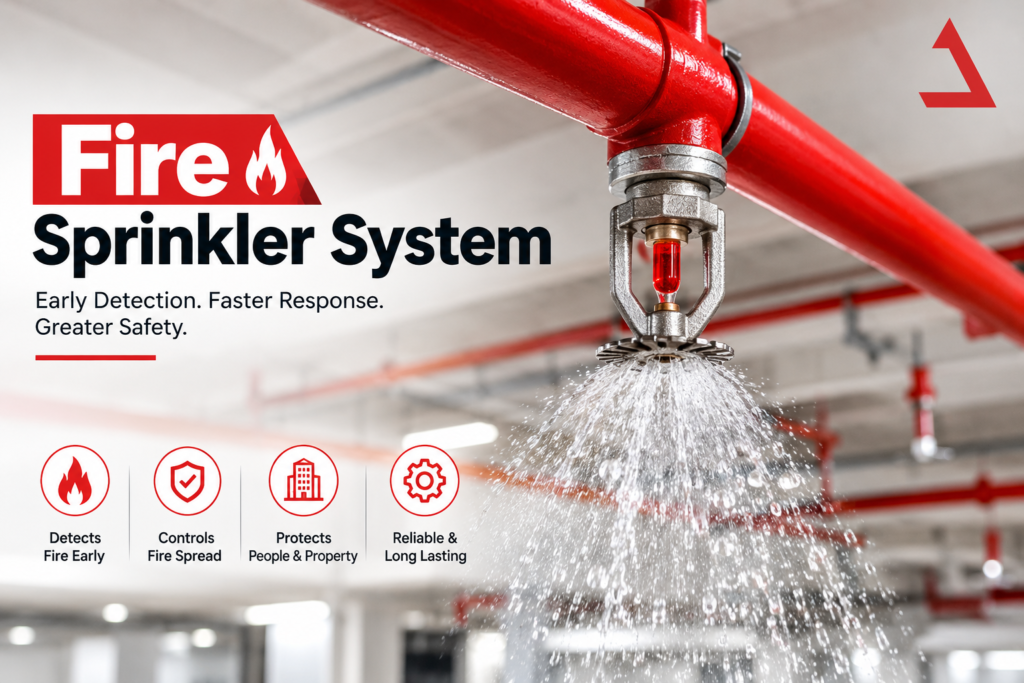
Fire safety is an essential part of protecting commercial buildings, industrial facilities, warehouses, offices, and other properties. A properly designed automatic sprinkler system can help control a fire in its early stages, reduce property damage, and improve occupant safety.
However, installing sprinkler heads alone is not enough. The entire system depends on correctly designed pipework, a reliable water supply, suitable valves, and properly installed components.
This is why fire sprinkler pipe installation requires careful planning, technical knowledge, and professional execution. Choosing experienced fire sprinkler system contractors also helps ensure that the system is suitable for the building, installed according to applicable requirements, and tested before being put into service.
In this guide, we explain how sprinkler piping works, what the installation process involves, which factors affect project costs, and how to choose a suitable fire protection contractor.
What Is Fire Sprinkler Pipe Installation?
Fire sprinkler pipe installation involves designing, supplying, assembling, and installing the pipe network that delivers water to sprinkler heads during a fire.
The pipes connect the water supply to the sprinkler system through components such as control valves, alarm valves, flow switches, and distribution branches.
When a sprinkler head activates because of sufficient heat, water flows through the connected piping and discharges over the protected area. In most conventional automatic sprinkler systems, individual sprinkler heads operate when exposed to the required activation temperature rather than all activating simultaneously.
The effectiveness of the installation depends on several factors, including:
- Correct hydraulic calculations and pipe sizing.
- Suitable pipe materials and fittings.
- Adequate water pressure and flow.
- Proper sprinkler head placement.
- Secure pipe supports and hangers.
- Correct valve installation and accessibility.
- Inspection, testing, and commissioning.
A well-planned installation helps the system deliver the required amount of water to the protected areas when it is needed.
Why Is Professional Fire Sprinkler Pipe Installation Important?
Fire sprinkler piping is a life-safety system, not simply a plumbing network. Errors in pipe sizing, installation, or water supply can affect its performance during an emergency.
Professional installation is important for several reasons.
1. Reliable Water Distribution
The piping network must deliver sufficient water to the operating sprinklers. Pipes that are incorrectly sized or arranged can create excessive pressure losses and prevent the system from meeting its design requirements.
Hydraulic calculations help determine the appropriate pipe diameters, available pressure, and expected water demand.
2. Compliance With Applicable Fire Safety Requirements
Fire protection requirements depend on the building’s occupancy, size, height, fire hazards, and applicable local regulations.
In India, the National Building Code of India 2016 provides a framework for building fire and life-safety provisions. IS 15105 is also an important Indian standard for the design and installation of fixed automatic sprinkler fire-extinguishing systems.
Project-specific requirements and the applicable versions of standards must be confirmed with the relevant authorities.
3. Reduced Risk of Leakage and System Failure
Poorly assembled joints, unsuitable fittings, inadequate pipe supports, and corrosion can compromise a sprinkler system.
Experienced installers follow appropriate assembly procedures, manufacturer instructions, and inspection requirements to help reduce these risks.
4. Better Long-Term Maintenance
A properly installed system provides easier access to valves, drains, test connections, and other serviceable components.
This makes routine inspections, maintenance, and repairs more manageable for facility managers.
Types of Fire Sprinkler Piping Systems
The right piping arrangement depends on the building environment, fire hazards, operating conditions, and system design.
Wet Pipe Sprinkler Systems
Wet pipe systems contain water in the sprinkler piping under normal operating conditions.
When a sprinkler activates, water is discharged through that sprinkler head.
These systems are widely used in commercial buildings, offices, hotels, and many industrial facilities where freezing is not a concern.
Main advantage: Water is readily available at the sprinkler head when the system operates.
Dry Pipe Sprinkler Systems
Dry pipe systems normally contain pressurised air or another approved gas in the sprinkler piping, with water held behind a control valve.
When a sprinkler operates, the pressure change allows the valve to open and water to enter the piping network.
These systems can be suitable for areas where water-filled pipes could freeze or where specific environmental conditions make a wet pipe system unsuitable.
Main consideration: The design must account for the time required for water to reach the operating sprinklers.
Pre-Action Sprinkler Systems
Pre-action systems use additional detection or control arrangements before water enters the sprinkler piping, depending on the selected configuration.
They are often considered for environments where accidental water discharge could damage sensitive equipment or valuable materials, such as certain data centres, archives, and specialised storage areas.
Their design and control logic must match the property’s risk profile and operational requirements.
Deluge Systems
Deluge systems use open discharge devices connected to a piping network. When the associated detection and release system operates, water is delivered through the open outlets.
They are commonly considered for certain high-hazard industrial applications where rapid application of water over a defined area is required.
These systems are different from conventional closed-head automatic sprinkler systems and require a suitable hazard-specific design.
Step-by-Step Fire Sprinkler Pipe Installation Process
A successful installation begins with engineering and ends with documented testing and commissioning. The following steps explain how a typical project is carried out.
Step 1: Site Survey and Fire Risk Assessment
The first step is to understand the building and its fire protection requirements.
The contractor or fire protection engineer reviews the building layout, occupancy, ceiling height, structural elements, storage arrangements, and potential fire hazards.
For industrial projects, the assessment may also consider machinery, combustible materials, production processes, and changes in building use.
The survey helps establish the appropriate sprinkler system type and the scope of installation work.
Step 2: Sprinkler System Design
After the site assessment, the system is designed to suit the building’s requirements.
The design typically addresses:
- Sprinkler head locations and spacing.
- Pipe routing and network configuration.
- Pipe diameters and hydraulic calculations.
- Water supply capacity and pressure.
- Control valves and alarm arrangements.
- Pipe supports and structural coordination.
- Drainage, testing, and maintenance access.
The design must account for obstructions such as beams, ducts, cable trays, and suspended ceilings.
A properly coordinated design can also reduce unnecessary pipe rerouting and conflicts with other building services.
Step 3: Selection of Pipes and Fittings
Selecting appropriate materials is an important part of fire sprinkler pipe installation.
Depending on the application and approved design, the system may use suitable steel piping or other specifically listed or approved materials.
The selection depends on factors such as system pressure, corrosion exposure, installation environment, compatibility, and applicable standards.
Contractors should verify that pipes, fittings, valves, and joining methods are suitable for the intended service.
Using a material simply because it is readily available or inexpensive can create problems if it is not approved for the application.
Step 4: Pipe Cutting, Preparation, and Assembly
The installation team prepares pipes according to the approved drawings and specified joining method.
Depending on the system, the work may involve threading, grooving, welding, or approved mechanical connections.
During this stage, installers should:
- Check pipes and fittings for visible damage.
- Prepare pipe ends correctly.
- Keep internal surfaces free from debris.
- Use compatible fittings and connection methods.
- Follow the manufacturer’s installation instructions.
- Protect open pipe ends during installation.
Correct preparation and assembly help reduce leakage and prevent foreign materials from entering the network.
Step 5: Pipe Supports and Hanger Installation
Sprinkler piping must be adequately supported to maintain its position and carry the loads associated with the installed system.
Support arrangements depend on pipe size, material, spacing requirements, building structure, and applicable design provisions.
Contractors should coordinate supports with structural members and other services.
Pipes should not be supported from unsuitable building components or installed in a way that compromises their stability.
Step 6: Installation of Sprinkler Heads and Valves
Once the piping network is installed, the team fits the required sprinkler heads, valves, and associated components according to the approved design.
Sprinkler head selection and placement must account for ceiling configuration, obstructions, temperature ratings, and the intended hazard classification.
Control valves must remain accessible for inspection and operation. Alarm and monitoring components should also be installed and connected as required by the design.
Step 7: Inspection, Testing, and Commissioning
Before the system is handed over, the installation must undergo the inspections and tests required by the approved design and applicable standards.
These may include pressure or leakage testing, flushing where required, verification of valve operation, alarm and flow testing, and checks of system monitoring arrangements.
The contractor should rectify identified defects and provide relevant test records and commissioning documentation.
The system should not be considered complete simply because the pipes and sprinkler heads are physically installed.
How to Choose the Right Fire Sprinkler System Contractors
Selecting a contractor is one of the most important decisions in a fire protection project.
The right contractor should understand the technical requirements of the building, coordinate effectively with other project teams, and provide a clear plan for installation and testing.
Here are some practical points to consider.
1. Review Relevant Project Experience
Look for contractors who have handled projects similar to yours.
A warehouse, office building, hotel, manufacturing plant, and data centre can have different fire protection requirements.
Ask about previous installations involving similar building types, hazards, system configurations, and project sizes.
2. Check Technical Design Capabilities
A suitable contractor should understand sprinkler layouts, hydraulic calculations, pipe sizing, water supply requirements, and equipment selection.
Ask whether the proposed design will be documented and coordinated with the building’s architectural, structural, and mechanical drawings.
3. Verify Compliance and Approvals
Discuss which standards and local requirements apply to your project.
For installations in India, confirm the relevance of NBC provisions, applicable BIS standards, local fire service requirements, and any project-specific approval conditions.
For example, the Delhi Fire Service states that automatic sprinkler system design and installation should follow IS 15105, with sprinkler design plans and calculations provided alongside building plans where required.
Requirements can vary according to jurisdiction and project circumstances, so approval should be verified rather than assumed.
4. Ask About Testing and Handover
A professional installation should include appropriate testing and commissioning.
Before appointing a contractor, confirm whether the scope includes inspection records, test certificates where applicable, as-built drawings, equipment information, and maintenance guidance.
These documents help the building owner understand the installed system and maintain it properly.
5. Compare the Scope of Work, Not Just the Price
Two quotations may have very different scopes even if their total prices appear similar.
Check whether the quotation includes:
- Design and hydraulic calculations.
- Pipes, fittings, valves, and sprinkler heads.
- Hangers, supports, and installation accessories.
- Labour and installation equipment.
- Testing and commissioning.
- Documentation and handover.
- Any exclusions, additional work, or civil modifications.
A clear scope makes it easier to compare proposals fairly and avoid unexpected expenses.
6. Consider Maintenance and After-Sales Support
Fire sprinkler systems require ongoing inspection, testing, and maintenance.
Ask whether the contractor can provide maintenance support or help coordinate future inspections, repairs, and system modifications.
A reliable maintenance plan helps identify issues before they compromise system readiness.
Common Fire Sprinkler Pipe Installation Mistakes to Avoid
Even a well-planned project can experience problems if installation details are overlooked.
The following mistakes deserve particular attention.
Incorrect pipe sizing: Pipes that do not meet hydraulic design requirements can affect the water available to operating sprinklers.
Poor pipe routing: Uncoordinated routing may create conflicts with ducts, electrical trays, ceilings, and other building services.
Inadequate supports: Incorrectly installed hangers or supports can allow piping to move or place unsuitable loads on the structure.
Obstructed sprinkler discharge: Beams, storage racks, decorative elements, or other obstructions can interfere with the intended sprinkler spray pattern.
Inaccessible valves: Valves that are hidden or difficult to reach can delay inspection, maintenance, or emergency operation.
Incomplete testing: Failing to carry out required inspections and commissioning checks can leave installation defects undetected.
Insufficient documentation: Missing drawings, test records, or equipment details can make future maintenance more difficult.
Avoiding these issues requires proper design, qualified installation personnel, effective site supervision, and documented quality checks.
What Factors Affect Fire Sprinkler Pipe Installation Cost?
There is no single price for every sprinkler installation. The cost depends on the building, the system design, the selected materials, and the extent of the work.
The main cost factors include:
Building Size and Layout
Larger buildings generally require more piping and sprinkler heads. Complex layouts may also increase installation time and coordination requirements.
Type of Sprinkler System
A conventional wet pipe system may have different cost requirements from a dry pipe, pre-action, or deluge system.
Additional detection, release, monitoring, or control equipment can affect the overall project budget.
Pipe Material and Diameter
Material specifications, pipe sizes, fittings, joining methods, and support requirements influence procurement and labour costs.
Water Supply Infrastructure
The project may require modifications to the water storage tank, fire pump arrangement, supply piping, or other associated infrastructure.
Site Conditions
Ceiling heights, access restrictions, existing building services, working hours, and whether the building is occupied can affect installation time and cost.
Testing and Documentation
The cost estimate should account for required inspections, testing, commissioning, documentation, and any approval-related work included in the agreed scope.
Practical advice: Request an itemised quotation based on the actual site conditions and approved design. This provides a more meaningful comparison than relying on a generic per-square-foot estimate.
Where Are Fire Sprinkler Systems Commonly Installed?
Fire sprinkler systems are used across many building types, subject to applicable requirements and the specific risks involved.
Commercial Buildings
Offices, shopping centres, hotels, and commercial complexes may require sprinkler protection based on occupancy and applicable fire safety provisions.
Warehouses and Storage Facilities
Storage arrangements, commodity characteristics, rack configuration, and ceiling height can significantly influence sprinkler design.
Industrial Facilities
Manufacturing plants and processing facilities may require conventional sprinklers or specialised fire protection systems according to the hazards present.
Hospitals and Healthcare Buildings
Healthcare facilities require careful consideration of patient safety, evacuation arrangements, building occupancy, and the applicable fire protection requirements.
Data Centres and Technical Facilities
These environments require a risk-based approach because water discharge, electrical equipment, and operational continuity must be considered together.
The appropriate solution may involve sprinklers, pre-action systems, or other fire suppression technologies, depending on the facility’s design and requirements.
Not every building requires the same sprinkler arrangement. The final design should be based on the applicable codes, the actual hazards, and the approved project requirements.
Why Choose Agnim Engineerz for Fire Protection Solutions?
Agnim Engineerz provides a point of contact for businesses seeking fire protection solutions for their facilities.
When planning a sprinkler installation, property owners and project teams should look for a service provider that understands the relationship between system design, installation quality, site coordination, and commissioning.
Before finalising a project, discuss the building’s requirements, intended protection areas, water supply arrangements, installation schedule, and applicable compliance obligations.
A clear technical scope helps establish realistic expectations and supports better coordination throughout the project.
To explore fire protection services and discuss your project requirements, visit the official website: https://agnimengineerz.com/.
Frequently Asked Questions
1. What is fire sprinkler pipe installation?
Fire sprinkler pipe installation is the process of installing the pipe network, fittings, valves, supports, and associated components that deliver water to sprinkler heads during a fire.
The work includes planning, pipe assembly, installation, inspection, testing, and commissioning.
2. How do I choose reliable fire sprinkler system contractors?
Review the contractor’s relevant project experience, technical capabilities, understanding of applicable standards, installation scope, testing procedures, documentation, and maintenance support.
Obtain an itemised quotation and confirm exactly what is included before awarding the contract.
3. Which pipes are used in fire sprinkler systems?
Suitable steel pipes are commonly used, while other listed or approved materials may be permitted for specific applications.
The correct choice depends on the system design, pressure requirements, installation environment, material compatibility, and applicable standards.
4. How long does fire sprinkler pipe installation take?
The duration depends on the building’s size, layout, system complexity, site access, material availability, and coordination with other contractors.
A small project may take substantially less time than a large industrial or commercial installation. A realistic schedule can be established after a site assessment and review of the approved design.
5. Is testing required after sprinkler pipe installation?
Yes. The completed system must undergo the inspections, tests, and commissioning procedures required by the approved design and applicable standards.
The contractor should correct identified defects and provide the relevant handover documentation.
6. What is the difference between a sprinkler system and a fire suppression system?
A sprinkler system is a type of fire protection system that typically uses water discharged through sprinkler heads.
Fire suppression is a broader term that includes sprinkler systems as well as other technologies, such as gaseous agents, foam, and specialised water-based systems.
The appropriate technology depends on the fire hazard, protected equipment, occupancy, and applicable requirements.
7. Does every commercial building need a fire sprinkler system?
Not necessarily. Requirements depend on factors such as occupancy classification, building height, floor area, use, local building regulations, and fire safety provisions.
The building’s requirements should be assessed against the applicable codes and the authority’s approval conditions.
Conclusion
Effective fire protection begins with a suitable design and continues through careful installation, testing, and maintenance.
Fire sprinkler pipe installation requires correct pipe sizing, suitable materials, secure supports, coordinated sprinkler placement, and a reliable water supply. Equally, selecting experienced fire sprinkler system contractors helps building owners manage technical requirements, installation quality, and project documentation.
Whether you are planning a new commercial building, upgrading an industrial facility, or reviewing an existing sprinkler network, start with a site assessment and a clearly defined technical scope.
For more information about fire protection solutions, visit Agnim Engineerz and discuss the requirements of your project.