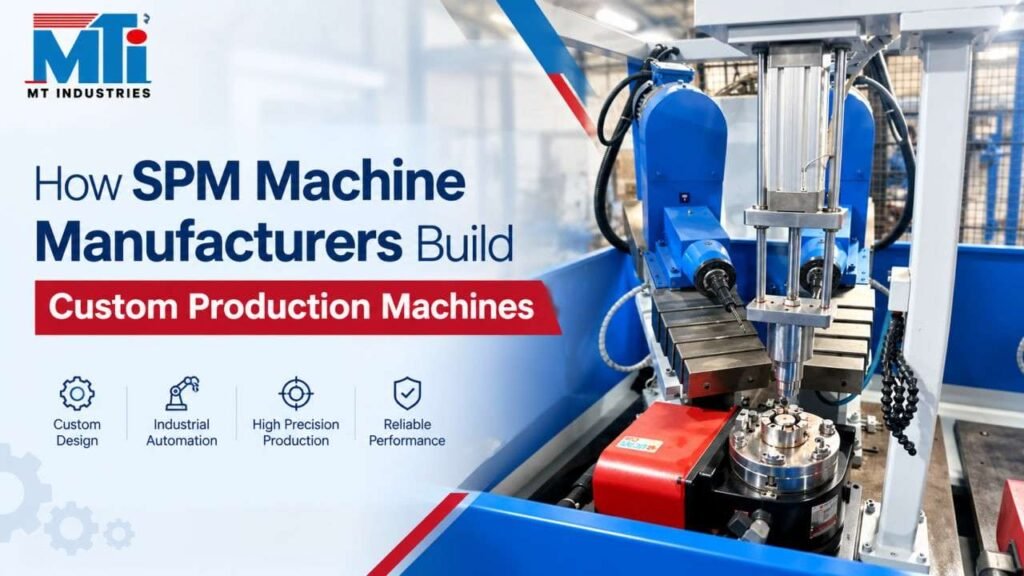
Modern manufacturing often requires more than standard machinery can provide. When a component has a specific geometry, demanding production volume, multiple machining operations, or strict cycle-time requirements, a customized machine can be a more practical solution than adapting several conventional machines.
This is where an experienced SPM Machine Manufacturer plays an important role. Custom production machines are designed around the component, manufacturing process, production volume, accuracy requirements, and available factory space. Instead of forcing a standard machine to perform an unsuitable process, the machine is engineered around the actual production requirement.
MT Industries develops Special Purpose Machines for applications where manufacturers need dedicated machining, drilling, tapping, assembly, or multi-operation capabilities. The objective is not simply to build a machine, but to create a production system that performs a defined manufacturing process consistently and efficiently.
What Is a Custom Production Machine?
A custom production machine is equipment designed specifically for a particular manufacturing operation or component. Unlike general-purpose machinery, it is engineered around a predetermined process.
For example, a production requirement may involve:
- Multiple drilling operations on one component
- Simultaneous machining at different positions
- Drilling and tapping in a single setup
- Automatic component loading and unloading
- Dedicated work holding and clamping
- Multiple operations within one machine cycle
- High-volume repetitive production
A custom SPM Machine Manufacturer studies these requirements before developing the machine architecture. This approach allows the equipment to be matched closely with the actual production process.
How Does an SPM Machine Manufacturer Build a Custom Machine?
Building a custom production machine involves several engineering stages. The process generally begins with understanding the component and ends with testing the completed machine under production conditions.
1. Understanding the Component and Production Requirement
The first step is understanding what the customer actually needs to manufacture.
Engineers typically study:
- Component drawings
- Material specifications
- Critical dimensions and tolerances
- Existing manufacturing processes
- Required production quantity
- Desired cycle time
- Number of operations
- Loading and unloading requirements
- Available floor space
- Operator involvement
This information determines the basic machine concept.
For example, a component requiring four holes at different positions may need a completely different solution from a component requiring drilling and tapping on several faces.
A good machine design therefore starts with the manufacturing requirement, not with a predefined machine configuration.
2. Process Planning and Operation Sequencing
After understanding the component, the manufacturer determines how each operation should be performed.
This includes deciding:
- Which operations can be performed simultaneously
- Which operations must be performed sequentially
- How the component should be positioned
- How tools should approach the workpiece
- How the component should be clamped
- How chips and coolant should be managed
- Where inspection or sensing may be required
Operation sequencing has a direct effect on cycle time.
If several compatible operations can safely occur at the same time, a machine may perform them simultaneously instead of processing them one after another. This can significantly improve productivity in high-volume manufacturing.
MT Industries considers the relationship between machining operations, work holding, tooling, and machine layout when developing dedicated production solutions.
3. Selecting the Machine Configuration
Once the process has been established, the engineering team develops an appropriate machine configuration.
Depending on the application, a custom machine may incorporate:
- Single or multiple machining heads
- Multi-spindle drilling arrangements
- Tapping units
- Hydraulic or pneumatic systems
- Servo-driven mechanisms
- Automatic workpiece handling
- Dedicated fixtures
- Sensors and interlocks
- Coolant systems
- Chip collection arrangements
The configuration depends on the component and production target.
For example, a multi-spindle drilling arrangement can allow several holes to be machined in one cycle. Similarly, combining drilling and tapping operations can eliminate unnecessary transfers between machines when the process allows it.
Also Read :- Special Purpose Machines Manufacturer
4. Designing Dedicated Work Holding
Work holding is one of the most important parts of a custom production machine.
The fixture must hold the component securely while maintaining its required position throughout machining. Poor work holding can lead to vibration, dimensional variation, tool wear, and inconsistent results.
A custom fixture is generally designed around:
- Component geometry
- Clamping locations
- Datum references
- Machining forces
- Accessibility for tools
- Loading and unloading method
- Required positioning accuracy
The fixture should also allow the operator or automation system to load the component consistently.
For automated production, sensors may be incorporated to verify component presence, correct seating, or clamping status before machining begins.
5. Integrating Industrial Automation Machines
Custom production equipment increasingly involves automation because manufacturers want to reduce manual handling and maintain consistent production.
Industrial Automation Machines can integrate functions such as:
- Automatic component loading
- Transfer mechanisms
- Robotic handling
- Part orientation
- Automatic clamping
- In-process sensing
- Automatic unloading
- Component counting
- Error detection
The level of automation depends on production volume and process requirements.
A low-volume application may only require assisted loading, while a high-volume production line may benefit from fully automated material handling.
The important point is that automation should solve a specific production problem. Adding unnecessary automation can increase complexity and maintenance requirements without providing a corresponding productivity benefit.
6. Engineering the Machine Structure
The mechanical structure must provide adequate rigidity and stability during operation.
Machine designers consider factors such as:
- Machining forces
- Vibration
- Tool movement
- Component weight
- Head positioning
- Fixture loading
- Long-term operating conditions
For high-volume production, structural stability becomes particularly important because the machine may operate for extended periods.
A rigid machine structure helps maintain positioning and machining consistency while reducing the effect of vibration during cutting.
7. Selecting Tooling and Cutting Parameters
Tooling selection is another important stage in custom machine development.
Engineers consider:
- Workpiece material
- Hole diameter
- Hole depth
- Thread specifications
- Required surface finish
- Cutting speed
- Feed rate
- Tool life
- Coolant requirements
For drilling and tapping applications, the tooling arrangement must also accommodate chip evacuation and tool replacement.
Correct tooling can influence cycle time, tool life, component quality, and overall operating cost.
MT Industries designs production solutions with consideration for the relationship between machining operations, tooling requirements, and the expected production cycle.
8. Electrical, Hydraulic, Pneumatic and Control Integration
A custom machine is more than its mechanical components. Its electrical and control systems determine how different functions interact.
Depending on the application, the machine may include:
- PLC-based controls
- HMI interface
- Servo systems
- Proximity sensors
- Pressure switches
- Pneumatic controls
- Hydraulic systems
- Safety interlocks
- Fault indications
- Cycle monitoring
The control system coordinates operations so that machining does not begin unless the required conditions are satisfied.
For example, the machine may verify that a component is correctly positioned and clamped before activating the machining cycle. Such interlocks help prevent incorrect operation and reduce the possibility of component or machine damage.
9. Testing and Production Validation
Before a custom machine is delivered, it must be tested against the agreed production requirements.
Testing can involve checking:
- Machine cycle time
- Component accuracy
- Repeatability
- Tool performance
- Fixture operation
- Automation sequences
- Safety functions
- Sensor responses
- Loading and unloading
- Continuous operation
Trial production is particularly valuable because it reveals practical issues that may not be obvious during the design stage.
A machine that performs well during an individual test cycle must also demonstrate stable performance over repeated production cycles.
10. Installation, Commissioning and Support
The final stage involves installing the machine at the production facility and commissioning it for actual use.
Commissioning may include:
- Machine installation
- Electrical and utility connections
- Alignment and setup
- Control-system verification
- Tool and fixture installation
- Trial production
- Operator training
- Final process validation
Ongoing support is also important because production requirements can change. Tooling, components, cycle requirements, or automation needs may evolve over time.
An experienced SPM Machine Manufacturer should therefore consider not only initial performance but also maintainability and future production requirements.
What Are the Main Benefits of Custom Production Machines?
Custom machines can provide several advantages when the application justifies dedicated equipment.
Higher Production Efficiency
Multiple compatible operations can be combined into a single production cycle, reducing unnecessary handling and machine transfers.
Reduced Cycle Time
Simultaneous operations and optimized process sequencing can reduce the time required to manufacture each component.
Consistent Production
Dedicated fixtures, controlled machining sequences, and automated processes can improve repeatability.
Reduced Manual Handling
Automation can reduce repetitive loading, unloading, and transfer activities.
Better Space Utilization
A machine designed around a specific process may consolidate several operations into one production system.
Application-Specific Performance
Instead of compromising around the limitations of standard machinery, the machine can be engineered around the component and process.
When Should a Manufacturer Consider a Custom SPM?
A custom solution may be worth considering when production involves high volumes, repetitive operations, strict cycle-time targets, multiple machining processes, or unusual component geometries.
It may be less suitable when components change frequently, production volumes are very low, or the required operation can be efficiently completed using readily available standard equipment.
The decision should therefore be based on production economics rather than customization alone.
How to Choose the Right SPM Machine Manufacturer?
Manufacturers should evaluate more than the machine’s initial price.
Important factors include:
- Engineering and design capability
- Experience with similar applications
- Fixture and tooling expertise
- Automation integration
- Machine accuracy and repeatability
- Testing procedures
- Maintenance accessibility
- After-sales technical support
- Ability to modify or upgrade the machine
A manufacturer should also be able to explain why a particular machine configuration is suitable for the application.
For companies evaluating potential suppliers, reviewing previous machine applications and discussing the complete manufacturing process can provide a better understanding of the manufacturer’s capabilities.
MT Industries approaches custom SPM development by connecting machine design with the specific machining and production requirements of the application.
Conclusion
Custom production machines are engineered solutions rather than off-the-shelf products. Their effectiveness depends on how well the machine architecture matches the component, process, production volume, cycle-time target, and automation requirements.
An experienced SPM Machine Manufacturer typically takes the project through several stages: requirement analysis, process planning, machine configuration, fixture design, tooling selection, automation integration, control development, testing, and commissioning.
For manufacturers with repetitive, high-volume, or complex machining requirements, this approach can create a more efficient and consistent production process. The right solution is not necessarily the machine with the most features—it is the machine that performs the required operations reliably, safely, and economically.
Frequently Asked Questions
1. What is an SPM machine used for?
An SPM is designed for a specific manufacturing application or group of repetitive operations. It can be used for drilling, tapping, machining, assembly, or multiple operations where dedicated production equipment can improve efficiency and consistency.
2. How long does it take to build a custom SPM?
The timeline depends on the component, machine complexity, number of operations, automation requirements, tooling, fixture design, and testing requirements. A simple dedicated machine generally requires less development time than a highly automated multi-operation system.
3. Can an SPM combine drilling and tapping operations?
Yes. A custom machine can be engineered to perform drilling and tapping operations within the same production cycle when the component and process requirements permit it. This can reduce handling and improve overall cycle efficiency.
4. Can custom SPMs include automatic loading and unloading?
Yes. Industrial Automation Machines can incorporate automatic loading, unloading, transfer systems, sensors, and other handling mechanisms. The appropriate automation level depends on production volume, component design, cycle time, and operator requirements.
5. What should I discuss with an SPM manufacturer before starting a project?
Provide the manufacturer with component drawings, material details, production volume, required operations, dimensional tolerances, target cycle time, existing process information, and automation expectations. These details allow the engineering team to develop a machine concept that matches the actual production requirement.
For More Information Click Here:- https://mtindustries.in/