India’s Vegetarian Protein Gap — Why the Most Practical Solution Starts With the Flour
India’s vegetarian protein deficiency is one of the most consequential and least adequately addressed nutritional problems in the country. Multiple large-scale nutrition surveys across the last decade have consistently found that the majority of Indian vegetarian households consume significantly less protein than recommended dietary allowances — not because vegetarian diets are inherently protein-deficient, but because the specific food patterns of most Indian vegetarian households don’t deliver adequate protein without deliberate planning that most households don’t apply.
The consequences of this chronic protein shortfall accumulate silently across years and decades. Slower muscle development and maintenance, contributing to the functional weakness and fatigue that affects a significant proportion of India’s middle-aged population before ageing-related decline would account for it. Impaired immune function, because antibodies and immune system proteins require adequate dietary protein for synthesis. Slower recovery from illness, injury, and the physiological demands of life events like surgery, childbirth, and physical exertion. And the hair, nail, and skin changes that signal protein inadequacy long before more serious clinical consequences appear.
Understanding why the protein gap exists — and specifically why flour choice is the most practical available intervention — requires looking at the actual protein delivery of the typical Indian vegetarian meal structure.
Why the Typical Indian Vegetarian Meal Falls Short on Protein
The Indian vegetarian meal is calorically adequate for most household members but structurally biased toward carbohydrate. A standard lunch of three rotis, dal, sabzi, and rice delivers the majority of its calories from carbohydrate — the rotis, rice, and the carbohydrate content of the vegetables — while the protein contribution of a standard dal serving, at typical portion sizes, covers perhaps a third of an adult’s daily requirement at one meal.
This isn’t a problem with Indian vegetarian food as a category — it’s a problem of proportion and protein source selection within the category. Dal is a good protein source, but standard portion sizes and preparation concentrations don’t always deliver the protein grams that adequate intake requires. Paneer is an excellent protein source but is expensive enough that it appears as a regular daily protein in fewer households than nutritional adequacy would require. Eggs, for households that include them, substantially improve the protein picture — but are absent from the strictest vegetarian households.
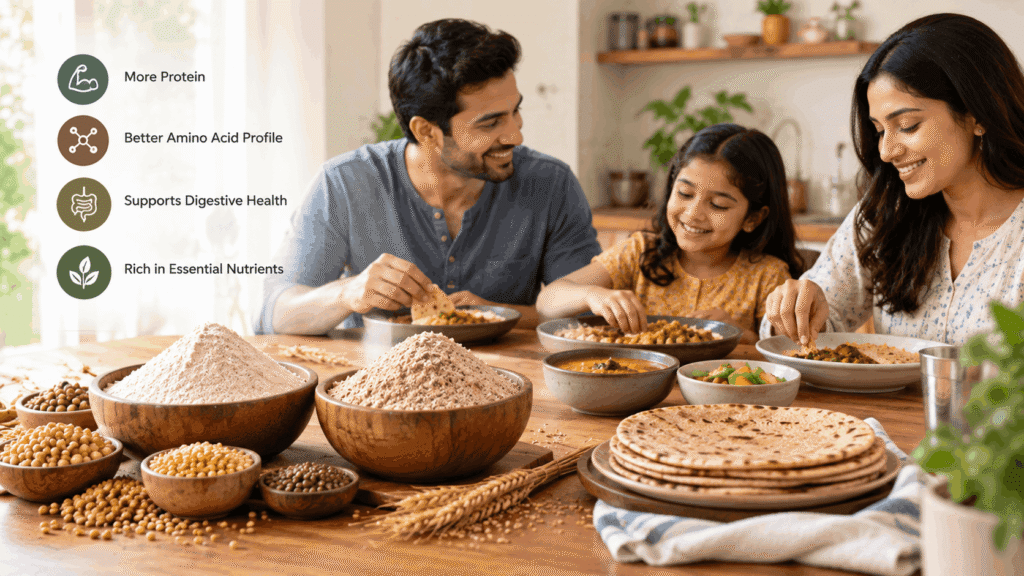
The roti — eaten in quantities of three to six per person per day across multiple meals — is the dietary constant that most effectively addresses this gap if the flour from which it’s made contributes meaningfully to protein intake. Standard refined wheat atta contributes modestly. A genuinely high-protein flour formulation contributes substantially — enough to change the protein balance of every roti-based meal rather than requiring separate protein additions to each.
What High Protein Atta Actually Changes in the Protein Calculation
The protein difference between standard refined wheat atta and a quality high protein atta is not marginal. Standard wheat atta delivers approximately 10-12 grams of protein per 100 grams of flour. A legume-enhanced high protein atta delivers 18-22 grams per 100 grams — a difference of roughly 70-80% more protein per unit of flour.
Applied to the daily roti consumption of an adult eating four rotis per day, this difference translates into approximately 8-10 additional grams of protein daily from the flour alone — enough to meaningfully shift the daily protein balance toward adequacy without any other dietary change.
For vegetarian households where dal protein varies by preparation, paneer appears inconsistently, and the other protein sources are unreliable in their daily contribution, the flour’s consistent protein delivery across every roti at every meal is the most reliable single intervention available.
The amino acid quality dimension compounds the benefit. Standard wheat flour’s amino acid profile is limited by its low lysine content. The legume additions in High Protein Atta — soybean and chickpea being the most nutritionally effective — are high in lysine, complementing wheat’s profile and producing a more complete protein source than either ingredient alone. For vegetarian households where protein quality, not just quantity, is the challenge, this complementarity is nutritionally meaningful.
The Role of Khapli Atta in Addressing Protein Intake Practically
The connection between khapli atta and the vegetarian protein gap is less direct than high protein atta’s contribution but is practically significant for a specific reason: higher protein intake, particularly from plant-based sources, is associated with increased digestive discomfort in people whose gut is accustomed to low-protein plant-based diets.
When a household increases its protein intake through legume-rich flour, the gut’s bacterial ecosystem adapts over time — but the transition period can involve bloating, gas, and digestive discomfort that makes households reduce their use of the high-protein flour before the adaptation is complete. This is one of the practical barriers to sustained high-protein flour use in households that switch to it.
Khapli atta‘s lower modern gluten content and ancient grain starch structure make it more digestively gentle than standard commercial wheat — which means that using khapli atta alongside or alternating with high protein atta during the transition period helps maintain gut comfort while the household’s protein intake increases. The combination reduces the digestive friction that can otherwise cause households to abandon the higher-protein flour before the benefits accumulate.
Plant Protein Completeness — What the Flour Combination Achieves
The broader nutritional argument for the high protein atta and khapli atta combination addresses protein quality across the complete range of amino acids that vegetarian households need to maintain from plant sources.
High protein atta’s legume additions provide lysine and complement wheat’s sulphur-containing amino acid profile. Khapli atta’s emmer wheat, while similar in amino acid profile to modern wheat, provides a slightly different distribution that varies the amino acid input across the meals where it’s used. Together, the two flours provide a roti-based protein source whose amino acid profile is more consistently complete across the week’s meals than any single flour achieves.
For vegetarian households — particularly those that don’t consume eggs and whose legume intake is variable — this amino acid diversity from the flour itself provides a more reliable protein quality baseline than relying on the variation in dal preparation and legume selection to deliver complete amino acids.
The Practical Household Implementation
The most effective implementation of the flour-based vegetarian protein solution doesn’t require announcing a dietary overhaul to the household. It requires maintaining high protein atta as the primary daily flour — replacing standard refined atta in the household’s main flour stock — and keeping khapli atta as the secondary flour for rotation into specific meal occasions and for the digestive comfort benefits it provides during higher-protein intake periods.
Most household members accept the transition without resistance because the roti’s appearance and basic taste remain familiar. The protein benefit accumulates silently across daily meals without requiring the household to eat differently — only to source differently.
10on10 foods produces both flours to the whole grain and clean ingredient standard that makes these nutritional benefits reliable — genuine legume-based protein elevation in the high protein atta rather than additive fortification, and whole grain emmer wheat in the khapli atta rather than a partially refined product that loses the digestive and nutritional benefits of the ancient grain.
The Problem Worth Solving
India’s vegetarian protein gap isn’t a niche nutritional concern — it’s a widespread, well-documented deficiency affecting the majority of Indian vegetarian households and contributing to health outcomes that reduce quality of life across the population. The solutions that nutrition science recommends — eat more dal, consume paneer regularly, add eggs — require dietary changes that face habit, preference, and cost barriers in many households.
The flour solution doesn’t face these barriers because it works through a product the household is already buying, in a format the household is already using, through meals the household is already making. The investment is a better flour choice. The return is a protein intake that meaningfully closes the gap that the typical Indian vegetarian diet leaves open.