Modern construction, industrial facility management, civil engineering, and commercial fit-outs depend heavily on Mobile Elevated Work Platforms (MEWPs). Scissor lifts, boom platforms, and vertical mast lifts have largely replaced traditional fixed scaffolding due to their superior manoeuvrability, rapid setup times, and efficiency. However, working at elevated heights remains one of the leading contributors to serious industrial incidents globally. Machine instability, electrocution risks, overhead obstruction entrapment, and operator error underscore the absolute necessity of rigorous, standardized safety education. This is where the International Powered Access Federation (IPAF) serves as the world-recognized benchmark. Enrolling operators in structured ipaf training is no longer just a best-practice recommendation; it is an essential compliance mandate enforced by main contractors, health and safety executives, and commercial developers worldwide.
Whether you are an individual technician seeking career advancement or a fleet manager looking for certified ipaf training centres to certify your site workforce, understanding course modules, machine categories, training investment, and site compliance is vital for operational excellence.
What is IPAF MEWP Training?
The International Powered Access Federation (IPAF) is a global non-profit organization dedicated to promoting the safe and effective use of powered access equipment. Comprehensive ipaf mewp training blends rigorous theoretical learning with hands-on practical driving evaluations to ensure operators thoroughly understand machine mechanics, ground stability principles, emergency override functions, and hazard mitigation.
Upon successfully completing both theoretical exams and practical driving evaluations, candidates earn an internationally recognized Powered Access Licence (PAL Card). The digital PAL Card is verifiable via the ePAL app, valid for five years, and accepted across major construction, industrial, and infrastructure sites globally.
Decoding IPAF Training Categories: 1b, 3a, and 3b
Access machinery varies significantly in geometry, chassis mobility, and stability mechanisms. To ensure precise operational competence, IPAF divides operator certification into distinct machinery categories.
| Category Code | Machine Architecture | Common Examples | Primary Use Cases |
| 1b | Static Boom | Spider lifts, van-mounted, truck-mounted booms | Facility maintenance, tree surgery, external glass cleaning |
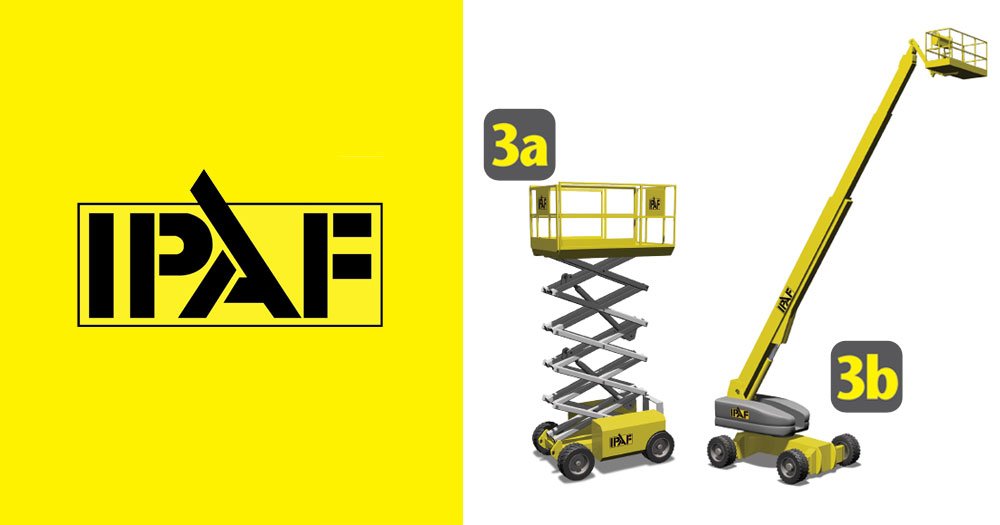
| 3a | Mobile Vertical | Electric & diesel scissor lifts, vertical personnel platforms | Indoor MEP work, warehouse racking, ceiling installations |
| 3b | Mobile Boom | Articulating (knuckle) and telescopic (straight) booms | High-rise steel erection, shipyard maintenance, cladding |
1. Static Boom Platforms: Category 1b Training
Specialized ipaf 1b training covers static boom equipment equipped with outriggers or stabilizing jacks. Because these machines cannot be driven while elevated, operators are heavily evaluated on outrigger deployment, ground bearing capacity assessment, spreader plate placement, and leveling procedures on sloping or sensitive surfaces.
2. Mobile Access Platforms: Category 3a and 3b Training
The vast majority of commercial job sites require dual certification on mobile equipment. Enrolling in comprehensive ipaf 3a 3b training prepares technicians to operate both vertical scissor platforms and mobile boom lifts safely.
-
Category 3a (Mobile Vertical): Focuses on operating machines that can be driven while elevated and move strictly along a vertical axis. Operators learn to navigate narrow factory aisles, manage platform payload limits, and avoid overhead electrical hazards.
-
Category 3b (Mobile Boom): Equips technicians to handle articulating and telescopic boom platforms capable of driving while elevated. Training emphasizes managing tailswing clearance, understanding up-and-over outreach geometry, and wearing full-body fall restraint harnesses with short lanyards anchored to designated basket points.
Combining these modules under unified ipaf 3a and 3b training courses provides operators with versatile site credentials, allowing them to switch seamlessly between scissor lifts and boom platforms as project demands evolve.
Locating Certified Centres and Evaluating Course Investment
Choosing where and how to conduct operator education directly influences training quality and official certification validity.
Finding Accredited Training Facilities
When searching for ipaf training near me, it is critical to select an officially accredited training facility rather than an unverified third-party provider. Authorized facilities feature purpose-built indoor and outdoor test sites equipped with ground obstacles, slope simulators, overhead hazard barriers, and up-to-date, TPI-certified machinery fleets.
Understanding IPAF Training Costs
A primary consideration for procurement officers and individual technicians is the financial outlay required for certification. Evaluating ipaf training cost parameters depends on several operational factors:
-
Single Category vs. Dual Category: Certifying on a single category (e.g., 3a only) requires less time and carries a lower fee than dual-category courses (such as combined 3a and 3b modules).
-
Delivery Method: Utilizing IPAF e-learning for theoretical modules allows students to complete coursework online prior to practical testing, reducing classroom time and lowering indirect labor downtime costs.
-
Group Corporate Rates: Authorized training facilities frequently offer discounted per-head rates for corporate group bookings or provide on-site mobile training setups for large contractor fleets.
While costs vary by region, investing in certified education yields significant long-term returns by preventing costly equipment damage, avoiding municipal HSE fines, eliminating site access delays, and, most importantly, protecting human life.
Core Safety Protocols Covered in IPAF Training
Professional operator education moves far beyond basic joystick controls. Candidates are trained to execute systematic safety checks before every shift.
Pre-Use Mechanical Audits
Before turning the ignition key, certified operators perform a complete visual and operational inspection. This includes auditing hydraulic hose integrity, checking engine fluid levels, testing limit switches, inspecting tilt alarms, and verifying ground-level emergency manual lowering functionality.
Ground and Surface Stability Assessment
Subsurface voids, uncompensated back fill soil, covered drainage trenches, and suspended floor slab load limits present hidden collapse hazards. Operators are trained to calculate gross machine weight against ground bearing capacity to ensure safe setup and driving parameters.
Fall Protection & Harness Inspection
For all Category 3b mobile boom operations, wearing a full-body fall restraint harness equipped with a short adjustable lanyard is an absolute requirement. Training modules instruct technicians on inspecting harness webbing, checking safety latches, and anchoring correctly to designated basket anchor points to prevent catapult incidents.
Conclusion: Elevating Safety and Career Competency
Standardized, accredited training is the single most effective investment a construction firm or technical operator can make in work-at-height management. Completing recognized courses ensures compliance with international HSE standards while building a culture of safety across active job sites. By choosing accredited facilities, understanding category distinctions, and prioritizing continuous skill development, contractors guarantee that every elevated project is completed safely, efficiently, and on schedule.
Read More: https://nicearticles.com