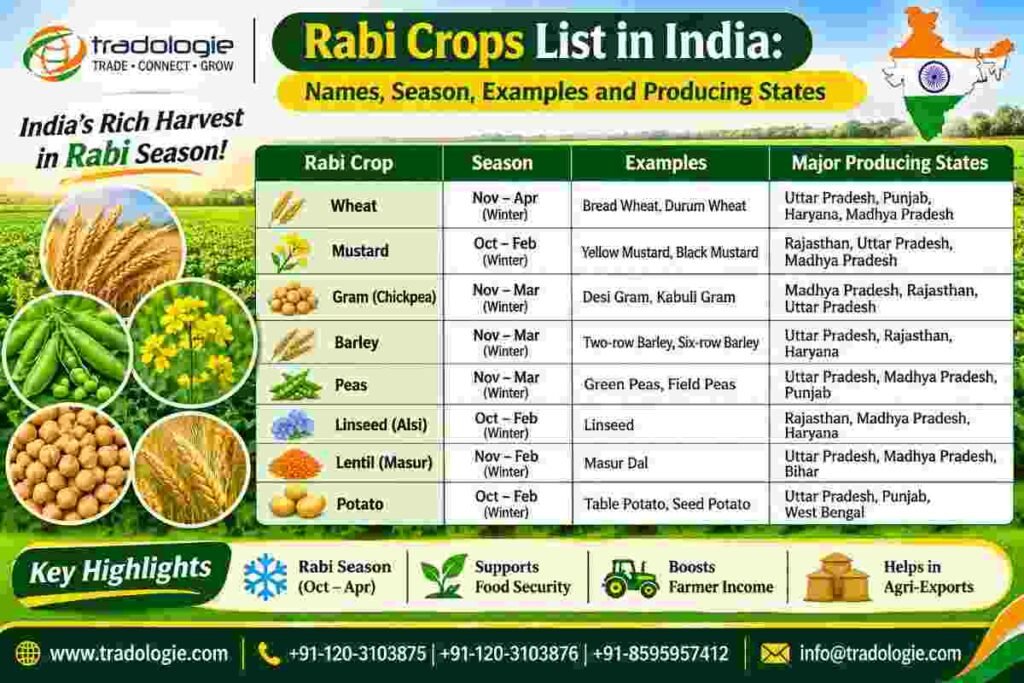
India’s winter cropping season plays an important role in agricultural production and food supply. During this period, farmers cultivate several important crops, including wheat, mustard, gram, barley, peas and lentils. These crops support domestic consumption, food processing and agricultural trade. Understanding the Rabi crops list in India helps farmers, students, traders and agricultural businesses learn about crop varieties, growing periods and major producing regions.
Rabi crops are generally sown after the monsoon season and harvested during spring. Their growth depends on suitable winter temperatures, soil moisture and irrigation facilities. This guide covers major Rabi crops, their categories, sowing and harvesting periods, and their importance in India’s agricultural market.
What Are Rabi Crops?
Rabi crops are winter-season crops grown mainly in India after the withdrawal of the southwest monsoon. The word Rabi originates from Arabic and refers to spring. These crops are generally sown during October and November and harvested between March and April, although the timing varies by crop and region.
Unlike Kharif crops, which largely depend on monsoon rainfall, Rabi crops generally require irrigation because they grow during the relatively dry winter months.
Quick Answer: Major Rabi crops in India include wheat, barley, mustard, gram (chickpea), peas, lentils, linseed, coriander, cumin and several winter vegetables. They are generally sown in October–November and harvested from March onwards.
Complete Rabi Crops List in India
The following list of Rabi crops covers major cereals, oilseeds, pulses, spices and vegetables cultivated during India’s winter season.
1. Cereal Rabi Crops
Cereals are an important part of India’s winter agricultural production. Wheat is the leading Rabi cereal, while barley and oats are also cultivated in different regions.
- Wheat: Uttar Pradesh, Punjab, Haryana, Madhya Pradesh and Rajasthan.
- Barley: Rajasthan, Uttar Pradesh, Haryana and Madhya Pradesh.
- Oats: Punjab, Haryana and Himachal Pradesh.
Wheat is widely used for flour, bread, biscuits and other food products. Businesses interested in agricultural sourcing can explore Wheat for relevant commodity categories and trading opportunities.
2. Oilseed Rabi Crops
Rabi oilseeds are important for edible oil production and food processing. Their cultivation contributes to India’s domestic oilseed supply.
- Mustard: Rajasthan, Haryana, Uttar Pradesh and Madhya Pradesh.
- Linseed: Madhya Pradesh, Uttar Pradesh and Chhattisgarh.
- Safflower: Maharashtra and Karnataka.
- Sunflower: Karnataka and Andhra Pradesh, including winter cultivation in suitable regions.
Mustard is one of India’s most important winter oilseed crops and is used for producing edible oil and other food products.
3. Pulse Rabi Crops
Pulses are an important source of plant-based protein and are widely used in Indian diets. Several varieties are cultivated during the Rabi season.
- Gram (Chickpea): Madhya Pradesh, Rajasthan, Maharashtra and Uttar Pradesh.
- Lentil (Masoor): Madhya Pradesh, Uttar Pradesh, Bihar and West Bengal.
- Peas: Uttar Pradesh, Madhya Pradesh, Punjab and Himachal Pradesh.
- Khesari (Grass Pea): Madhya Pradesh, Bihar and West Bengal.
These crops are important for domestic food consumption, wholesale markets and international commodity trade. Buyers can explore Pulses to discover different agricultural product categories.
4. Spice and Condiment Rabi Crops
Several commercially important spices are cultivated during the winter season, particularly in Rajasthan, Gujarat and Madhya Pradesh.
- Coriander: Rajasthan, Madhya Pradesh and Gujarat.
- Cumin (Jeera): Rajasthan and Gujarat.
- Fenugreek (Methi): Rajasthan, Gujarat and Madhya Pradesh.
- Fennel (Saunf): Rajasthan and Gujarat.
- Ajwain: Rajasthan, Gujarat and Madhya Pradesh.
India’s spice production supports domestic food processing and export markets. Businesses interested in sourcing these products can explore Indian Spices.
5. Rabi Vegetable Crops
Winter vegetables are cultivated across different Indian states depending on climate, soil and irrigation facilities.
Common Rabi vegetables include:
- Potato
- Onion
- Carrot
- Cauliflower
- Cabbage
- Spinach
- Garlic
- Peas
These vegetables supply local markets, wholesale mandis, food processing businesses and retailers.
Rabi Crops and Their Sowing and Harvesting Months
The sowing and harvesting periods of Rabi crops differ according to crop variety, location and weather conditions. The following table provides general seasonal periods.
| Crop | Sowing Period | Harvesting Period |
|---|---|---|
| Wheat | October–November | March–April |
| Barley | October–November | March–April |
| Mustard | October–November | February–March |
| Gram | October–November | February–March |
| Lentil | October–November | March–April |
| Peas | October–November | January–March |
| Coriander | October–November | February–March |
| Cumin | November–December | February–March |
| Potato | October–November | January–March |
| Garlic | October–November | March–April |
Difference Between Rabi and Kharif Crops
Rabi and Kharif are India’s two major cropping seasons. Their main difference is the time of cultivation and the weather conditions required for crop growth.
| Feature | Rabi Crops | Kharif Crops |
|---|---|---|
| Season | Winter | Monsoon |
| Sowing | October–November | June–July |
| Harvesting | March–April | September–October |
| Water Source | Mainly irrigation | Mainly rainfall |
| Climate | Cool and relatively dry | Warm and humid |
| Examples | Wheat, Gram, Mustard | Rice, Maize, Cotton |
For more information, explore the Kharif Crops List in India and understand the differences between India’s seasonal crop patterns.
Importance of Rabi Crops in India’s Agricultural Trade
Rabi crops contribute to India’s food supply and create opportunities for procurement, processing, storage and commodity trading. Wheat, mustard, gram and lentils are important commodities for wholesalers, food manufacturers, exporters and institutional buyers.
Understanding the Rabi crops list can help businesses:
- Plan procurement around harvesting periods.
- Identify major crop-producing states.
- Manage inventory and storage requirements.
- Understand seasonal commodity availability.
- Explore domestic and international sourcing opportunities.
Tradologie is an AI-powered B2B trade platform that connects buyers and suppliers across agricultural and industrial product categories. Businesses can explore Agro Commodities and connect with potential trading partners.
Interested businesses can register as a buyer or register as a seller to explore trade opportunities.
Frequently Asked Questions About Rabi Crops
1. What are the major Rabi crops in India?
Major Rabi crops include wheat, barley, mustard, gram, peas, lentils, linseed, coriander and cumin.
2. When are Rabi crops sown in India?
Most Rabi crops are sown between October and November after the monsoon season. However, sowing periods vary depending on the crop and region.
3. Which is the most important Rabi crop in India?
Wheat is one of India’s most important Rabi crops because it is a major staple food and contributes significantly to the country’s food grain supply.
4. Which states produce the most Rabi crops?
Uttar Pradesh, Punjab, Haryana, Madhya Pradesh and Rajasthan are among the major Rabi crop-producing states. The leading state varies according to the crop.
5. Why do Rabi crops require irrigation?
Rabi crops grow mainly during the winter months when monsoon rainfall is limited. Irrigation helps maintain adequate soil moisture for crop growth.
Conclusion
Rabi crops are essential to India’s agricultural system, supporting food production, rural livelihoods and commodity markets. Wheat, mustard, gram, barley, pulses and winter vegetables are among the major crops cultivated during this season.
Understanding the Rabi crops list in India, their growing periods and producing states helps farmers and agricultural businesses make informed decisions about cultivation, procurement and trade. With the right market information and sourcing connections, businesses can explore opportunities across India’s agricultural supply chain.