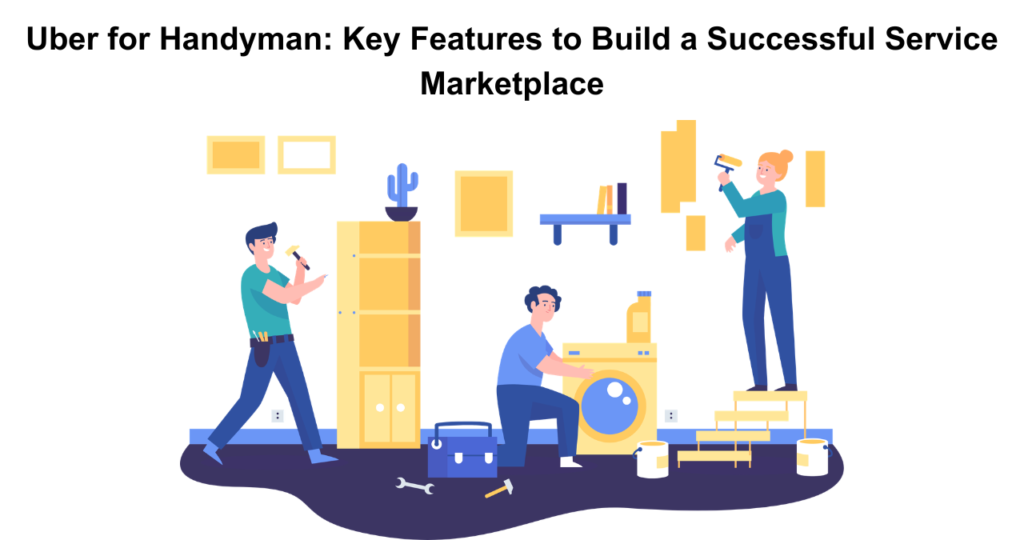
The on-demand service economy has changed how people find and hire professionals for everyday household work. Customers no longer want to spend hours searching for a reliable electrician, plumber, cleaner, carpenter, painter, or repair professional. They expect to open an app, select a service, view available professionals, book an appointment, track the request, and complete payment with minimal effort.
This shift has created a strong opportunity for entrepreneurs and startups looking to build digital marketplaces for local services. A well-designed Uber for Handyman can connect customers with skilled professionals through a convenient platform while giving service providers a structured way to manage bookings and grow their customer base.
The concept is similar to the convenience offered by ride-hailing platforms, but instead of connecting passengers with drivers, the marketplace connects customers with professionals who handle household and maintenance requirements. The business model can cover multiple categories, including plumbing, electrical repairs, appliance servicing, painting, carpentry, cleaning, gardening, moving assistance, and other home maintenance services.
For businesses entering this market, the objective should not simply be to copy an existing application. The focus should be on creating a marketplace that solves local customer problems, supports service providers, and can expand into additional service categories over time.
Why the Handyman Service Marketplace Is Growing
Home maintenance is a recurring requirement in almost every market. From small repairs to larger household projects, customers regularly need professionals they can trust. Traditional methods of finding these professionals often depend on personal recommendations, local advertisements, directories, or phone calls.
Mobile platforms make this process more convenient.
An on demand handyman app can bring customers and professionals together through one centralized marketplace. Customers can search for services, compare professionals, select convenient appointment times, and receive updates from the application.
For entrepreneurs, this creates an opportunity to build a marketplace around local demand rather than operating as a traditional service company.
A successful marketplace can serve individual homeowners, tenants, property managers, offices, landlords, and businesses. This makes the model suitable for both consumer-focused and B2B expansion.
Another important advantage is the ability to organize fragmented local handyman services into a structured digital ecosystem. Instead of customers contacting different professionals separately, they can manage several service requirements from one application.
How an Uber-Style Handyman Marketplace Works
The basic operation of a handyman marketplace is straightforward.
A customer opens the application and selects the required service. The platform displays relevant service categories and allows the customer to provide information about the job. Depending on the service, customers may upload photographs, describe the problem, select a preferred appointment time, or choose an immediate service request.
The platform then identifies suitable professionals based on factors such as service category, location, availability, ratings, and other business rules.
The professional receives the request and can accept or reject it. Once accepted, the customer receives confirmation and can follow the booking status through the application.
For urgent requirements, the platform can support immediate requests. For planned maintenance, customers can schedule appointments for a later date.
This operating model makes Handyman App Like Uber a practical approach for businesses that want to digitize local service discovery and booking.

Key Features to Build a Successful Handyman Marketplace
The features of the platform directly influence customer experience, provider adoption, and operational efficiency. A strong marketplace should include features for customers, service professionals, and administrators.
Easy Customer Registration and Profile Management
Customers should be able to create an account quickly using common registration methods. The profile can contain contact details, saved addresses, booking history, preferred payment methods, and other relevant information.
A simple onboarding process reduces friction and helps customers reach the service selection screen quickly.
Businesses can also allow customers to manage multiple addresses. This is useful for people who own more than one property or need services at different locations.
Service Category Discovery
The marketplace should organize services into clear categories.
For example, categories can include:
- Plumbing
- Electrical work
- Carpentry
- Painting
- Appliance repair
- Cleaning
- Pest control
- AC and appliance servicing
- Furniture assembly
- Gardening
- Moving assistance
- General maintenance
A search and filter system can make it easier for customers to find the right service.
The platform should also support subcategories. A customer searching for a handyman plumber, for example, should be able to find plumbing-related services without browsing through unrelated categories.
Detailed Service Listings
Every service should have a clear description so customers understand what they are requesting.
A service listing can explain the type of work covered, expected service duration, professional requirements, availability, and other relevant information.
Clear service information reduces misunderstandings between customers and professionals.
It also helps the platform maintain consistent service categories as the marketplace grows.
Professional Profiles
Customers need confidence before allowing someone to enter their home or property. Professional profiles can help establish that trust.
A profile can include:
- Professional name
- Profile photograph
- Service categories
- Experience information
- Customer ratings
- Reviews
- Completed jobs
- Availability
- Service locations
- Verification status
A transparent profile system helps customers make better decisions while encouraging professionals to maintain high service standards.
Location-Based Professional Matching
Location is one of the most important elements of a local service marketplace.
The platform should identify professionals who operate within the customer’s selected service area. Matching can consider distance, service category, availability, professional status, ratings, and other marketplace rules.
Location-based matching can also help reduce unnecessary travel time and improve response times.
This feature is particularly valuable for businesses operating an Uber for Home Services model where customers expect professionals to be available within their local area.
Real-Time Booking Status
Customers should be able to understand what is happening with their service request.
The application can show statuses such as request submitted, professional assigned, booking confirmed, professional on the way, service started, and service completed.
This creates transparency throughout the booking process.
Scheduled and Instant Services
Not every home service requires immediate assistance.
A broken pipe may require urgent attention, while painting, furniture assembly, or routine maintenance can be scheduled in advance.
A successful platform should therefore support both immediate and scheduled bookings.
This flexibility allows the marketplace to serve different customer requirements without creating separate systems for each service type.
Service Request Details
Customers should have a convenient way to explain their requirements.
The booking interface can allow customers to add descriptions, upload photographs, specify property details, and provide instructions.
For example, someone requesting appliance repair can upload a photograph of the appliance and describe the issue. A plumber can review this information before accepting the request.
This can improve communication and help professionals prepare for the job.
In-App Communication
Communication between customers and service providers is important for many household jobs.
An integrated chat feature can allow customers and professionals to discuss access instructions, job details, arrival information, and other requirements.
The platform can also support notifications when a message is received.
Keeping communication inside the application can make the booking process more organized.
Ratings and Reviews
Ratings and reviews are essential for marketplace trust.
After completing a service, customers should be able to rate their experience and provide feedback. Professionals can also be allowed to provide feedback about customers where appropriate.
Reviews can help new customers evaluate professionals and help marketplace operators identify service quality issues.
A transparent rating system also creates an incentive for professionals to maintain consistent standards.
Digital Payments
A modern service marketplace should provide convenient payment options.
Depending on the target market, businesses can support cards, digital wallets, bank-based payment methods, and other locally relevant payment options.
The application should clearly display transaction information and booking records so customers can understand what they have paid for.
Payment flexibility can make the platform more convenient for international as well as local markets.
Push Notifications
Notifications keep customers and professionals informed without requiring them to repeatedly open the application.
Notifications can be used for booking confirmations, professional assignment, arrival updates, schedule changes, payment confirmations, promotional offers, and service completion.
The notification strategy should remain useful rather than overwhelming users with unnecessary messages.
Booking History
Customers should be able to access previous bookings from their account.
Booking history can help users quickly find past services, review previous professionals, repeat common services, and maintain records.
For professionals, booking history can provide information about completed jobs, earnings, customer interactions, and service activity.
Repeat Booking
Many household services are recurring.
Customers may regularly require cleaning, gardening, appliance maintenance, AC servicing, or other local handyman services.
A repeat booking option allows customers to request a similar service without starting the entire process again.
This can improve customer retention and increase the frequency of marketplace transactions.
Features for Handyman and Service Professionals
A marketplace cannot succeed only through customer-facing functionality. Professionals need efficient tools to manage their work.
Professional Registration
Service providers should have a simple registration process where they can submit their basic information, service categories, operating locations, and other required details.
Depending on the business model and local regulations, the platform can include an appropriate verification process.
Availability Management
Professionals should control when they are available to receive service requests.
They can mark working hours, unavailable periods, holidays, or temporary breaks.
Accurate availability information reduces failed bookings and improves the customer experience.
Job Request Management
Professionals need a central place to view incoming requests.
They should be able to review customer information, service requirements, location, preferred schedule, and other relevant details before accepting a job.
This is a fundamental feature of an Uber Like App For Handyman because the marketplace depends on efficient job-provider matching.
Earnings Dashboard
Professionals should be able to understand their completed work and financial activity.
A dashboard can display completed bookings, current earnings, previous transactions, and other relevant business information.
Transparent earnings information can improve provider confidence and encourage professionals to remain active on the platform.
Service Area Management
Professionals may not want to accept requests from every location.
Allowing them to define service areas can help improve operational efficiency. The platform can prioritize professionals who are available and operate within the requested location.
Job Status Updates
Professionals should be able to update the progress of a booking.
For example, they can confirm acceptance, mark arrival, start the service, and complete the job.
These updates can automatically inform the customer and reduce the need for manual communication.
Read More: Why White-Label Solutions Fastest Way to Launch a Handyman App Like Uber?
Admin Features for Marketplace Management
The administration side of the platform plays a major role in maintaining marketplace quality.
Administrators should have access to tools for managing customers, professionals, service categories, bookings, transactions, reviews, promotions, and platform activity.
User and Professional Management
Administrators need visibility into registered users and service providers.
They should be able to review profiles, manage account status, handle verification processes, and respond to operational issues.
Service Category Management
As the marketplace grows, administrators may add new services or modify existing categories.
A flexible category management system allows the business to expand without restructuring the entire marketplace.
Booking Management
Administrators should be able to monitor active and completed bookings, resolve booking issues, and review service activity.
This is particularly important when operating across multiple cities or regions.
Review and Complaint Management
Customer feedback can help identify recurring problems.
Administrators should have tools to review complaints, investigate disputes, and take appropriate action when marketplace standards are not being followed.
Promotional Management
Promotional tools can help businesses attract new customers and encourage repeat bookings.
Administrators can create campaigns for specific services, locations, customer groups, or seasonal requirements.
Promotions should support the broader customer acquisition strategy rather than simply reducing transaction value.
Building a Marketplace Around Trust
Trust is more important in home services than in many other app categories because customers may invite professionals into private residences or workplaces.
An effective Uber for Home Services platform should therefore place strong emphasis on professional verification, customer reviews, transparent profiles, clear service information, and reliable communication.
Verification requirements can vary by market and service category. Businesses should understand local rules before defining their provider onboarding process.
Trust is not created by one feature. It comes from combining several elements into a consistent customer experience.
How to Make Handyman App Like Uber Stand Out
The market for on-demand services can be competitive. Simply launching another marketplace may not be enough.
Entrepreneurs should identify a specific customer problem or underserved market.
For example, a platform could focus on rapid emergency repairs, property maintenance for landlords, commercial maintenance, recurring home services, premium professionals, or services for specific communities.
Another approach is geographic specialization.
A startup can begin with a focused local market, build supply and demand, improve its operations, and then expand into additional locations.
The platform can also introduce multiple service categories gradually instead of launching with too many categories at once.
Supporting Local Handyman Services
Digital marketplaces can provide small and independent professionals with access to customers they might not reach through traditional marketing.
Local handyman services often operate through referrals and repeat customers. A marketplace can provide an additional digital channel for customer acquisition.
Professionals can showcase their expertise, collect reviews, manage appointments, and receive service requests through one platform.
For entrepreneurs, this creates a two-sided marketplace where customer demand and professional supply reinforce each other.
The challenge is to maintain a healthy balance between both sides. A platform with many customers but insufficient professionals will create poor response times. A platform with many professionals but limited customer demand may struggle with provider retention.
Creating a Better Experience Than Traditional Service Booking
A successful Handyman App Like Uber should focus on reducing the effort required to book and manage services.
Customers should not have to make multiple calls to find an available professional. They should not need to repeatedly ask for arrival updates. They should have access to relevant information before confirming a booking.
Similarly, professionals should not need to manage requests across different messaging applications and manual records.
The marketplace becomes valuable when it simplifies both sides of the transaction.
Why a Handyman Clone App Can Help Startups Enter the Market
Building a service marketplace from the beginning requires considerable planning across product design, business workflows, user roles, service categories, booking processes, and marketplace operations.
A handyman clone app can provide a ready-made foundation based on an established service marketplace model. Entrepreneurs can customize the platform according to their target market, service categories, branding, and business requirements.
This approach can be particularly useful for startups that want to validate an idea and enter the market without creating every marketplace function from zero.
However, customization remains important. Different countries and cities can have different customer expectations, service categories, payment preferences, and operational requirements.
The platform should therefore be adapted to the actual market rather than treated as a one-size-fits-all solution.
Important Considerations for Handyman App Development
Successful handyman app development requires more than adding a list of features.
The user journey should be simple from registration through service completion. Service categories should be easy to understand. Provider profiles should communicate trust. Booking statuses should remain clear. Notifications should provide useful information at the right time.
The platform should also be designed with expansion in mind.
A startup may begin with plumbing and electrical services but later introduce cleaning, appliance repair, painting, moving, gardening, or commercial maintenance.
A flexible marketplace structure allows new services and locations to be introduced as the business grows.
Businesses should also consider localization. Language, currency, payment methods, address formats, service terminology, and customer behavior can vary significantly between countries.
Choosing the Right Business Model
A handyman marketplace can support different monetization structures depending on its target market.
The platform may generate revenue through commissions on completed services, service fees, subscription programs, professional memberships, promotional placements, or combinations of these models.
The right approach depends on customer behavior, provider economics, competition, and market conditions.
Entrepreneurs should test the business model against real marketplace activity rather than selecting a monetization strategy only because another platform uses it.
Expanding Beyond Basic Handyman Services
Once a platform develops a strong customer base, the business can expand into additional categories.
A marketplace that begins with an On-Demand Handyman Services App can gradually introduce home cleaning, appliance repair, beauty services, moving assistance, pest control, gardening, and other household requirements.
This expansion can increase customer lifetime value because users can access several services through the same account.
It also creates opportunities for professionals to reach additional customer segments.
The long-term objective can be to develop a broader home services marketplace rather than remaining limited to a single handyman category.
What Makes Handyman App Like Uber Successful?
A successful platform combines convenience, reliability, marketplace supply, and customer trust.
Technology is important, but technology alone does not guarantee marketplace success.
The business must attract qualified professionals, generate customer demand, maintain service quality, provide reliable support, and continuously improve the user experience.
The strongest platforms are usually those that understand the local market and build their service model around actual customer needs.
For startups, launching with a focused service category or geographic area can make marketplace operations easier to manage. Once the model proves successful, the business can expand to additional categories and regions.
The Future of On-Demand Home Services
Consumer expectations around convenience continue to evolve. People increasingly expect digital platforms to help them manage everyday tasks quickly.
This creates opportunities for businesses developing an on demand handyman app that connects customers with professionals through mobile technology.
Artificial intelligence, location intelligence, automated matching, digital payments, customer analytics, and personalized recommendations can further improve service marketplaces over time.
For example, platforms can use customer booking history to recommend recurring maintenance services. Intelligent matching can help identify suitable professionals based on location, service category, availability, and previous performance.
The future of home services will likely involve more connected and personalized digital experiences.
For entrepreneurs, this creates an opportunity to build specialized platforms rather than simply competing as another generic service directory.
Conclusion
The demand for convenient home maintenance and repair services creates a strong opportunity for entrepreneurs and startups to build digital service marketplaces. A well-planned Uber for Handyman platform can connect customers with qualified professionals while simplifying booking, communication, service management, and customer retention.
The key is to focus on practical features such as service discovery, professional profiles, location-based matching, scheduled bookings, real-time status updates, communication, reviews, digital payments, and provider management. Businesses should also understand their target market and adapt the platform to local customer expectations.
Handyman App Like Uber provides a practical foundation for entrepreneurs who want to enter the on-demand service industry. With the right market strategy, service quality, technology, and customer experience, the concept can expand from a local marketplace into a larger home services platform.
For startups and businesses planning to launch this type of marketplace, partnering with an experienced clone app development company can help turn the business concept into a scalable digital service platform while allowing the product to be customized for specific market requirements.
Frequently Asked Questions
1. What is an Uber for Handyman app?
An Uber for Handyman app is a digital marketplace that connects customers with professionals such as plumbers, electricians, carpenters, cleaners, painters, and other service providers. Customers can discover services, book professionals, receive updates, and manage their service requests through the application.
2. What features should a handyman marketplace include?
A strong marketplace should include customer registration, service categories, professional profiles, location-based matching, booking management, scheduled services, real-time status updates, communication, ratings and reviews, notifications, digital payments, booking history, and professional management tools.
3. Is a handyman clone app suitable for startups?
Yes. A handyman clone app can provide startups with an established foundation for launching a service marketplace. The platform can be customized according to the startup’s target market, service categories, branding, operating region, and business requirements.
4. Can a Handyman App Like Uber support multiple service categories?
Yes. The platform can be structured to support multiple categories such as plumbing, electrical work, cleaning, carpentry, painting, appliance repair, gardening, pest control, and other home maintenance services. Businesses can add categories as their marketplace grows.
5. Can the platform be expanded to multiple countries or cities?
Yes. A well-designed marketplace can be adapted for different locations by supporting relevant languages, currencies, payment methods, service categories, operating areas, and local business requirements. Entrepreneurs can start in one market and expand after establishing sufficient customer and professional demand.