Every industrial facility, regardless of sector, depends on three water-related systems working reliably in the background: the boiler that generates steam or heat, the treatment plant that handles process wastewater, and the system that manages domestic sewage from the site. When any one of these is neglected, the consequences show up quickly — equipment failure, regulatory penalties, or plain operational inefficiency. This guide takes an in-depth look at Boiler Water Treatment, Industrial Effluent Treatment Plants, and Sewage Treatment Plants, and why each deserves dedicated attention rather than being treated as an afterthought.
Why Boiler Water Treatment Is Non-Negotiable
Boilers are among the most capital-intensive assets in any plant, and they are also among the most sensitive to water quality. Raw or poorly treated feed water introduces dissolved minerals, dissolved gases, and suspended solids into the boiler system — and under high heat and pressure, these impurities cause problems that are expensive to reverse.
The Core Problems Untreated Boiler Water Causes
- Scale formation: Calcium and magnesium salts precipitate on heat transfer surfaces, insulating them and forcing the boiler to work harder to produce the same output. Even a thin layer of scale can significantly increase fuel consumption.
- Corrosion: Dissolved oxygen and carbon dioxide in feed water attack boiler tubes and steam lines, leading to pitting, leaks, and premature tube failure.
- Carryover: High dissolved solids or improper blowdown control can cause boiler water to carry over into the steam system, contaminating downstream equipment and reducing steam quality.
- Sludge and deposits: Suspended solids settle in low-flow areas, creating localized overheating and hot spots that can lead to tube rupture.
What a Proper Boiler Water Treatment Program Includes
A comprehensive Boiler Water Treatment program typically combines external and internal treatment strategies:
- External treatment — softening, dealkalization, reverse osmosis, or demineralization of makeup water before it enters the boiler, reducing hardness and dissolved solids at the source.
- Deaeration — mechanical and chemical removal of dissolved oxygen and CO2 to prevent oxygen-driven corrosion.
- Internal chemical treatment — dosing of scale inhibitors, oxygen scavengers, alkalinity builders, and condensate line corrosion inhibitors tailored to the specific boiler type and operating pressure.
- Blowdown control — managing the concentration of dissolved solids within the boiler by removing a controlled portion of boiler water, based on regular water testing.
- Routine monitoring — testing for pH, hardness, conductivity, dissolved oxygen, and silica to catch deviations before they cause damage.
The right program depends heavily on boiler type (fire-tube vs. water-tube), operating pressure, and fuel source, which is why a generic, one-size-fits-all chemical dosing approach rarely works well in practice. Facilities that invest in a properly engineered boiler water treatment program typically see longer equipment life, lower fuel costs, fewer unplanned shutdowns, and reduced maintenance spend over the life of the asset.
Industrial Effluent Treatment Plants: Managing Process Wastewater Responsibly
Almost every manufacturing process generates wastewater carrying a mix of organic matter, oils, heavy metals, dyes, or other contaminants specific to that industry. Discharging this untreated, or even partially treated, effluent into the environment is both illegal in most jurisdictions and environmentally damaging. This is the role an Industrial Effluent Treatment Plant (ETP) is built to fill.
How an Industrial ETP Works
Most ETPs are designed around a staged treatment approach, since no single process can remove every type of contaminant:
- Primary treatment: Screening, oil-water separation, and equalization to remove large solids and even out flow and load variations before further processing.
- Secondary treatment: Biological treatment (activated sludge process, sequencing batch reactors, or moving bed biofilm reactors) to break down organic pollutants using microorganisms.
- Tertiary treatment: Filtration, chemical coagulation-flocculation, and sometimes membrane processes to remove residual suspended solids, color, or specific contaminants like heavy metals.
- Sludge management: Dewatering and disposal or reuse of the solid waste generated during treatment.
Why Industry-Specific Design Matters
An ETP for a textile dyeing unit looks very different from one serving a pharmaceutical plant or a food processing facility, because the pollutant load, chemical composition, and regulatory discharge limits vary widely by sector. A textile ETP, for instance, needs a strong focus on color and dye removal, while a pharmaceutical ETP often requires specialized handling for antibiotic residues and pH-sensitive processes.
Getting ETP design and operation right isn’t just about avoiding fines — it directly impacts a facility’s ability to reuse treated water internally, which is increasingly important as water costs rise and regulatory bodies push industries toward recycling. In many cases, a well-run ETP is also the first treatment stage feeding into a zero liquid discharge system, meaning that inefficiencies here cascade into higher costs downstream.
Sewage Treatment Plants: Handling Domestic Wastewater On-Site
While industrial effluent gets most of the regulatory attention, domestic sewage generated by staff canteens, washrooms, and residential townships attached to industrial sites also needs proper treatment. A Sewage Treatment Plant (STP) is designed specifically for this purpose, and its treatment approach differs meaningfully from an industrial ETP because the contaminant profile is different — primarily organic matter, pathogens, and nutrients like nitrogen and phosphorus, rather than industrial chemicals or heavy metals.
Typical STP Treatment Stages
- Preliminary treatment: Screening and grit removal to eliminate large debris and sand.
- Primary settling: Allowing heavier solids to settle out before biological treatment.
- Biological treatment: Commonly using activated sludge, sequencing batch reactors (SBR), or moving bed biofilm reactor (MBBR) technology to break down organic waste through microbial action.
- Secondary clarification: Separating treated water from biological sludge.
- Disinfection: Chlorination, UV treatment, or ozonation to eliminate pathogens before discharge or reuse.
- Tertiary polishing (optional): Additional filtration for facilities that want to reuse treated sewage for gardening, flushing, or cooling makeup water.
Why STPs Matter for Industrial Sites
Many industrial facilities, especially larger campuses with on-site housing or large workforces, are required by local regulations to treat sewage on-site rather than relying solely on municipal infrastructure — particularly in areas where municipal sewage systems are limited or overloaded. Beyond compliance, a well-maintained STP allows facilities to reuse treated water for landscaping, toilet flushing, or non-potable process applications, reducing overall freshwater demand.
Poorly maintained STPs, on the other hand, tend to produce foul odors, inconsistent treatment quality, and can become a source of regulatory non-compliance — issues that are usually traceable to inadequate biological loading design or inconsistent operation and maintenance.
How These Three Systems Work Together
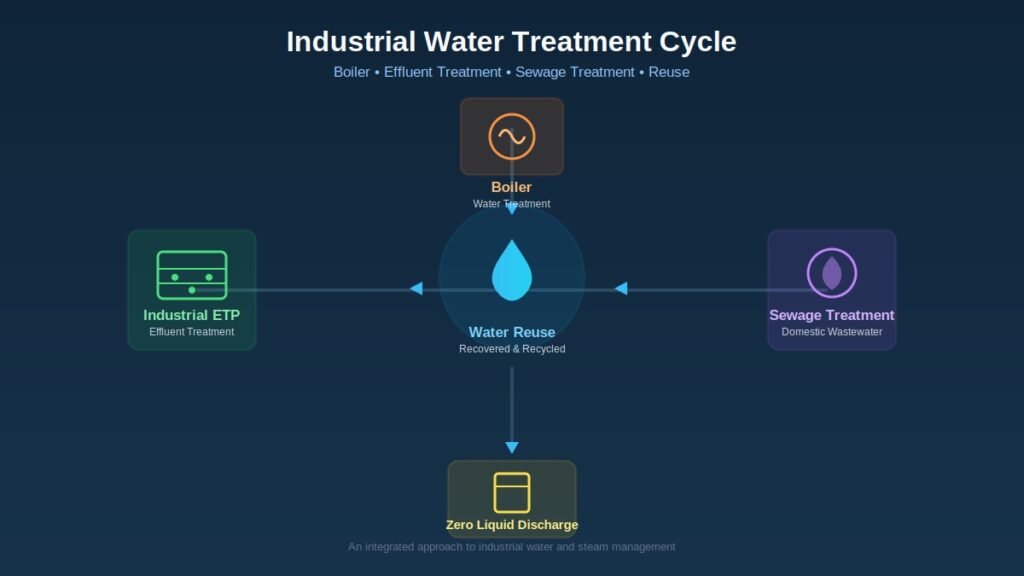
While boiler water treatment, industrial effluent treatment, and sewage treatment plants are often managed as separate line items in a facility’s operations, they are deeply interconnected in practice:
- Boiler blowdown often becomes part of the effluent stream that an ETP has to handle, meaning better boiler water chemistry can directly reduce ETP load.
- Treated effluent from an ETP can, in many cases, be polished further and reused as boiler makeup water or cooling water, closing the loop on water consumption.
- Treated sewage from an STP is frequently reused for non-potable applications on-site, reducing the facility’s overall freshwater intake and, indirectly, the volume of wastewater that needs to be managed elsewhere.
Facilities that plan these systems holistically — rather than installing each in isolation to meet a specific regulatory requirement — tend to achieve significantly better outcomes: lower total water costs, fewer compliance issues, reduced downtime, and a stronger sustainability profile overall.
Final Thoughts
Water and steam systems are the circulatory system of most industrial operations, and neglecting any single component — the boiler, the effluent treatment plant, or the sewage treatment plant — creates risk that eventually surfaces as cost, whether through equipment failure, regulatory penalties, or lost production time. A well-designed, professionally maintained approach to boiler water treatment, industrial effluent treatment, and sewage treatment doesn’t just keep a facility compliant; it lays the groundwork for genuine water efficiency and long-term operational reliability.