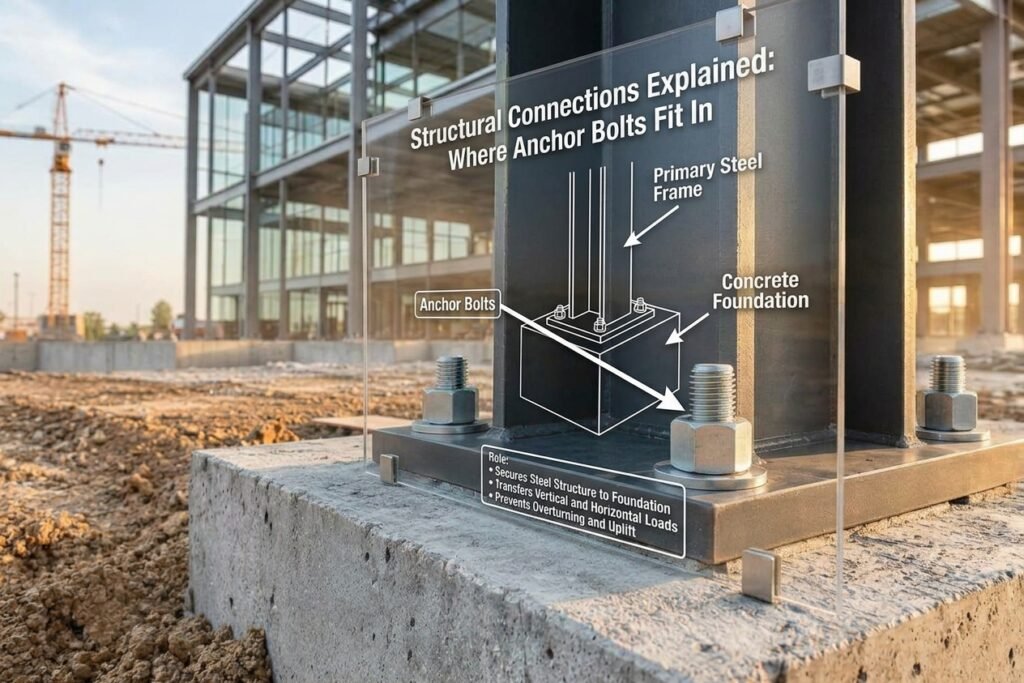
A steel structure is really a long chain of connections. Beams meet columns, columns meet each other, and at the very bottom, the whole frame meets the ground. Most conversations about connections focus on the joints people can see, like the bolted splices and welded corners. Yet the one that ties everything to the foundation is usually a handful of Anchor Bolts, and it deserves the same attention. This article walks through the main kinds of structural connections and shows exactly where Anchor Bolts fit.
What a connection is supposed to do
A connection has one job: move force from one member to another without letting the joint fail or deform more than the design allows. Those forces arrive as axial load, shear, bending moment, or a mix of all three. Each connection is designed for what it will actually see, and the strength of the whole system depends on its weakest link. A frame with excellent beams and a weak base is still a weak frame.
The main types of connections
Engineers usually sort connections by how they are made and how they behave.
- Welded connections fuse members together and can be very stiff, though they need skilled labor and careful inspection.
- Bolted connections clamp plates and angles together with high-strength structural bolts. Bearing-type joints rely on bolts pressing against the edges of the holes, while slip-critical joints rely on friction created by high pretension.
- Simple (shear) connections carry vertical shear and let the end of a beam rotate slightly. A typical beam-to-girder web connection is an example.
- Moment connections carry bending as well, so the joint resists rotation. They’re common in rigid frames.
- Base connections transfer the column’s forces into the foundation. This is the odd one out, because the load leaves steel and enters concrete.
Where Anchor Bolts fit in the chain
Picture the path a load takes. It starts at a roof or floor, moves into beams, passes into columns, reaches the base plate, travels through the Anchor Bolts and the grout, and finally spreads into the concrete foundation and the soil below.
Anchor Bolts are the link between two materials that behave very differently. Steel is ductile and uniform. Concrete is strong in compression, weak in tension, and prone to cracking. The bolts have to work across both.
Under ordinary gravity load, the base plate mostly bears on the grout and concrete, so the bolts may carry little. The picture changes with wind, seismic action, or overturning. The column tries to lift or slide, and the bolts take over, resisting uplift in tension and sliding in shear.
Anchor Bolts and structural bolts are not the same
They look alike, but they do different jobs. Structural bolts, covered by ASTM F3125 (which now includes the older A325 and A490 designations), join steel to steel and are tightened to a high, controlled pretension. Anchor Bolts, often specified to ASTM F1554, connect steel to concrete and are embedded in the foundation. In AISC documents they are often called anchor rods.
Mixing the two up is a classic error. A structural bolt isn’t automatically a suitable anchor, because its head, thread, and material properties are made for a different purpose. Specify each for the job it has to do.
Pinned bases and fixed bases
The amount of moment a base must resist changes the whole detail.
A pinned base is designed mainly for axial load and shear, with little moment. It usually has a modest base plate and four anchor rods placed close to the column. Its job is to hold the column in position, resist uplift and sliding, and allow a small amount of rotation.
A fixed base resists bending too. It needs a larger plate and anchor rods spaced farther from the column, often with stiffeners or deeper embedment, so one side of the plate can go into tension while the other bears on grout. Fixed bases give a stiffer frame, but they demand more from the foundation and are less forgiving of installation errors.
Real bases sit somewhere between the two. What matters is that the detail matches the assumption used in the structural analysis. If the model assumes a pinned base and the field detail behaves like a fixed one, forces end up where nobody planned for them.
How the force actually travels
Whatever the base type, the bolt group has to be checked against several limits, and the lowest one governs.
In tension, the steel rod can yield or fracture, the surrounding concrete can break out in a cone, the anchor can pull out, or the concrete near an edge can blow out sideways. In shear, the bolt can bear and bend against the plate hole, the concrete can break at the edge, or a short anchor can pry out a piece of concrete behind it.
Details that look minor change these results. A thick grout pad or leveling nuts create stand-off that increases bending in the bolt. A thin plate can bend and concentrate force on one bolt. Engineers account for these effects, which is why shortcuts on site can undo careful calculations.
Checking what arrives on site
A connection is only as good as the material that reaches the job. Ask for mill certificates, grade markings, thread and coating details, and compare them to the specification before anything is installed. Suppliers differ in what they make, test, and document, so compare them on certification and size range, not just price. UAE-based manufacturers such as Petrofast Middle East FZC, which lists stud anchors among its products, are one example of what’s available to projects in the region. Whoever you choose, reject anything that doesn’t match the paperwork.
Erection and tolerances
Most trouble with Anchor Bolts begins at erection. A few habits prevent it:
- Use a rigid template to hold the bolts in position during the pour, and survey them afterward.
- Check the projection above the concrete so the nut will have full thread engagement after the plate, grout, and washer are in place.
- Don’t bend or torch bolts to make a plate fit. Report the mismatch and let the engineer decide.
- Use the specified washers and nuts, and set leveling devices as the design allows.
- Fill the space under the plate with proper grout so bearing is even.
- Tighten to the specified method, record it, and recheck where vibration is expected.
Common mistakes to avoid
- Cutting bolts short, leaving too few threads in the nut
- Using hooked bolts where heavy tension calls for headed anchors
- Oversized plate holes without plate washers
- Mixing bolt, nut, and washer grades
- Ignoring grout thickness when calculating shear
- Leaving no record of what was installed
None of these is dramatic on its own. Together, they explain a large share of base connection problems.
Putting it together
Structural connections work as a system, and the base is where that system meets the ground. Anchor Bolts are small compared to the frame above them, but they are the reason the frame stays put when wind, seismic motion, or equipment loads try to move it. Understanding where they sit in the load path, how they differ from structural bolts, and how the base type changes their job makes it far easier to specify, install, and inspect them well. Always follow the project engineer’s specifications and the applicable code.