Key Takeaways
- Disconnected systems are a revenue and guest-experience problem, not just an IT inconvenience.
- Real-time, two-way sync between the channel manager, booking engine and PMS removes the root cause of most overbookings and rate mismatches.
- Automated POS-to-PMS folio posting improves efficiency by cutting missed charges, manual corrections and checkout disputes.
- Unified guest profiles let front-line staff personalise each stay, which improves the guest experience.
- With Dubai hotel occupancy at 80.7% in 2025, hotels that fix data accuracy first stay more competitive in a fast-moving market.
- Most hotels don’t need to replace everything. Audit first, then integrate what you already own.
It’s 11 p.m. during a major exhibition week. A guest who booked through an online travel agency (OTA) two months ago reaches the front desk. The PMS shows no available room. The OTA shows a confirmed reservation. Somewhere between the channel manager and the property management system, an update arrived late, or never arrived at all.
Now the duty manager is hunting for a comparable room, apologising, and absorbing the cost of an upgrade or a relocation.
Dubai hotels rarely lack software. Most run a PMS, a restaurant and spa POS, a booking engine, a channel manager, a payment gateway and a CRM. Each works well on its own. The trouble starts when they have to agree with each other. The visible symptoms are overbookings, missed restaurant charges, mismatched rates, hours of manual reconciliation and guests who feel the hotel doesn’t know them.
This guide explains why hotel software integration in Dubai stays so difficult, what the gaps cost, and how owners, general managers, IT directors and revenue managers can evaluate a practical fix. If you’re comparing hotel management software in Dubai or reviewing the stack you already run, start here.
What a Connected Hotel Technology System Should Look Like
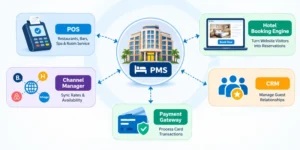
Before we look at why systems fail to talk, it helps to name the players and what each one owns. Buying several capable tools doesn’t automatically create a connected operation. Connection is a separate piece of work.
Property Management System (PMS)
The PMS handles reservations, room assignments, check-in and check-out, guest profiles and room status. For most hotels it acts as the operational hub of the front office. When other systems send it bad data, every department that trusts it inherits the error.
Point of Sale (POS) and Hotel Booking Engine
The POS records transactions at restaurants, bars, spas and room service. The booking engine turns direct website visitors into reservations. One captures what guests spend on property. The other captures how they arrive. Both need to write back to the PMS accurately and quickly.
Channel Manager, CRM and Payment Gateway
The channel manager pushes availability and rates to OTAs and pulls reservations back. The CRM holds guest relationships, preferences and history. The payment gateway processes card transactions and deposits. These three must exchange accurate information instead of keeping their own conflicting versions of the truth.
Here’s the catch: a hotel can own best-in-class versions of all six and still run a disconnected operation. Many hotels that invest in structured Hospitality Software Development find the biggest gains come from how data moves between systems, not from adding another application.
Why Dubai Hotels Still Struggle With Disconnected Systems
Most integration failures aren’t caused by bad software. They come from how the stack was assembled, often over several years and several owners.
Legacy Systems and Outdated Integration Methods
Older platforms often depend on batch updates, scheduled file exports or narrow interfaces. A batch that runs every 30 minutes is fine on a quiet Tuesday. During an exhibition week, a 30-minute gap is long enough to sell the same room twice.
Vendor Lock-In and Closed APIs
Some vendors restrict access to their data or charge per integration. When a hotel wants to add a newer booking, payment or guest-experience tool, a proprietary interface can turn a simple connection into a paid project with a long queue.
Different Vendors, Different Data Formats
One system may identify a room by number, another by type code, a third by an internal ID. A guest may be a profile in the PMS, an email address in the CRM and a name string on a POS check. Mapping fields, reconciling records and handling failed updates requires deliberate integration design. Without it, errors pile up silently.
Acquisitions and Multi-Property Operations
Hotel groups often inherit a different PMS, POS and finance platform with every property they add. Central reporting becomes a monthly spreadsheet exercise, and processes drift from one hotel to the next. Groups that bring in a system integrator in Dubai early tend to standardise data definitions before the problem spreads across the portfolio.
The distinction matters. Buying another tool is a software purchasing decision. Making your existing tools exchange reliable data is an integration architecture problem. Treating one as the other is why so many hotels keep spending and keep struggling.
Quick Question: “Is a disconnected hotel system always an IT problem?”— No. It usually shows up first as a finance, front-office or revenue problem: a disputed folio, an unexplained room-night variance or a rate that differs between channels. IT inherits the fix, but the cost lands across the business.
Seven Business Problems Caused by Poor Hotel System Integration
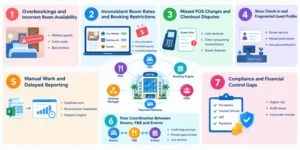
Technical failures only matter when they hit the P&L or the guest. These seven do both.
1. Overbookings and Incorrect Room Availability
When an OTA booking, a cancellation or a room block reaches the PMS late, a room can stay open after it’s sold. Picture New Year’s Eve or a large trade show, when demand spikes and the last rooms go in minutes. One delayed update can mean a walked guest, a compensation cost and a bad review. Timely inventory updates and exception alerts are the difference between a quick fix and a front-desk crisis.
2. Inconsistent Room Rates and Booking Restrictions
Different prices, minimum-stay rules or cancellation terms across channels confuse guests and weaken rate control. A guest who finds a lower rate on one OTA than on your own site loses trust in your direct channel. Revenue managers then spend days correcting parity instead of shaping strategy.
3. Missed POS Charges and Checkout Disputes
If a restaurant, spa, minibar or room-service charge doesn’t reach the guest folio, the hotel either loses the revenue or argues about it at checkout. Both outcomes cost money. Front-office and finance teams also spend extra hours matching POS reports to folios by hand.
4. Slow Check-In and Fragmented Guest Profiles
When staff have to look up information in separate systems, check-in slows down. Stay history, room preferences and past complaints that live in a different database never reach the person greeting the guest. Personalisation becomes guesswork.
5. Manual Work and Delayed Reporting
Spreadsheet exports, duplicate data entry and end-of-day reconciliation consume skilled hours. Reports from different systems rarely match, so managers spend their mornings investigating discrepancies instead of acting on what the numbers say.
6. Poor Coordination Between Rooms, F&B and Events
A corporate group may need a room block, a banquet, a private dining space and negotiated rates. If these live in separate workflows, one team can promise what another can’t deliver. Group business is high value, so coordination errors are expensive.
7. Compliance and Financial Control Gaps
Accurate occupancy records, Tourism Dirham calculations, VAT treatment and payment controls all depend on clean data. Disconnected systems increase the chance of errors and make audits harder to support. To be clear, integration alone doesn’t guarantee compliance. It does give finance teams a single, traceable record to work from.
Dubai-Specific Pressures That Make Integration More Urgent
Dubai’s hotel market amplifies every integration weakness. Use the figures below as market context, not as proof that every property suffers the same failures.
High Occupancy and Event-Driven Demand
According to the Dubai Department of Economy and Tourism (DET), Dubai welcomed 19.59 million international overnight visitors in 2025, up 5% from 18.72 million in 2024. Average hotel occupancy reached 80.7%, up from 78.2%, across 154,264 rooms in 827 establishments. Average daily rates rose 8% to AED 579.
At those levels, an inventory error is expensive. When rooms are scarce and rates are high, a double-booked night costs more than the room itself. Exhibitions, conferences, holiday peaks and December’s record of 2.04 million visitors in a single month put constant pressure on how fast availability updates travel.
OTA Commissions and Direct-Booking Profitability
OTA commissions are commonly cited in an indicative 15–25% range, though real rates vary by contract and channel. Inconsistent rates, unreliable availability and poor guest recognition make it harder to win the direct booking. Better integration supports cleaner distribution management and a stronger direct channel, but it doesn’t guarantee lower commissions.
Hotels building their own distribution tools often explore hospitality digital solutions Dubai to gain more control over how inventory, rates and bookings flow between direct and third-party channels.
Multi-Outlet Hospitality Operations
Many Dubai hotels run several restaurants, a lounge, a spa, a pool bar, banquet space and room service under one roof. Real-time POS-to-PMS posting and accurate departmental reporting matter more with every added outlet, because each one is another place where a charge can go missing.
Tourism Dirham, VAT and Local Reporting
Dubai hotels collect the Tourism Dirham, a per-room, per-night fee that ranges from AED 7 to AED 20 depending on the property’s classification, with the charge capped at the first 30 consecutive nights of a stay. Standard UAE VAT sits on top of room revenue. Reconciling occupied room nights, applicable fees and VAT-related transactions requires accurate records and close coordination between the PMS and finance systems. Hotels should always confirm current rates and procedures with DET and UAE Federal Tax Authority guidance.
How Disconnected Systems Affect Hotel Revenue and Guest Loyalty
The operational symptoms above add up to a business case.
Revenue Leakage Extends Beyond Lost Room Sales
Incorrect inventory, missed POS charges, rate discrepancies and manual corrections all chip away at margin. Each error looks small. Across rooms, outlets and reporting periods, they accumulate.
A hypothetical example: suppose a hotel misses an average of AED 120 on eight folios a night because minibar and spa charges don’t post. That’s AED 960 a night, or roughly AED 350,000 a year. This is an illustration, not a benchmark, and any real estimate needs the property’s own data.
Operational Costs Increase When Staff Must Reconcile Data Manually
Repeated data entry, discrepancy hunts, folio corrections and report preparation all take staff time. The opportunity cost is just as real as the payroll cost. Every hour spent matching spreadsheets is an hour not spent on guest service or revenue strategy.
Guest Loyalty Suffers When Service Feels Disconnected
Guests notice when they have to repeat their preferences, dispute a charge or find different terms on different websites. Reliable data sharing lets staff greet a returning guest properly, honour a preference and close out a bill without friction.
Consider how a team might trace an inventory mismatch. A guest arrives with an OTA confirmation. The front desk checks the PMS and finds the room taken. Staff then check the channel manager and find that the last availability update failed to push. Next they check the integration log, if one exists, and discover a timeout that nobody was alerted to. With monitoring and alerts, that failure surfaces in minutes. Without them, it surfaces at the front desk.
Quick Question: “Can better integration really improve guest loyalty?”— It can help. When the front desk sees a guest’s full history, bills are accurate and offers match what the guest booked, there are fewer reasons to complain. It supports loyalty, though it doesn’t create it on its own.
What Effective PMS, POS and Booking System Integration Looks Like
You don’t have to replace every platform. You do need a clear picture of what good looks like.
Real-Time, Two-Way Data Synchronization
Room availability, rates, reservation changes and cancellations should flow between relevant systems in both directions, within seconds. Good designs include error handling, automatic retries, monitoring and alerts when an update fails. A failed sync you can see is manageable. A failed sync nobody notices is how overbookings happen.
Automated POS-to-PMS Folio Posting
Authorised restaurant, spa and room-service transactions should reach the correct guest folio automatically. That requires duplicate prevention, unique transaction references and exception queues for charges that can’t be matched.
Unified Guest Profiles and Better Personalization
Permitted guest information can sync across the PMS, CRM and service systems so staff see one view. This needs clear access controls and privacy safeguards, so each team sees only what it needs.
Open APIs, Security and Audit Trails
Documented APIs, secure authentication, role-based permissions, logging and reliable vendor support are the foundation. Hotels that plan ahead for API development in Dubai can connect new tools without waiting on a single vendor’s roadmap. Agreed data contracts, meaning written rules for what each field means and how errors are handled, keep multiple vendors aligned.
Centralized Reporting Across Multiple Properties
Consistent operational and financial reporting across hotels, outlets and departments depends on standardised data definitions and reconciliation rules. Without them, group-level numbers can’t be compared.
Measure success by data accuracy, synchronization reliability, fewer manual interventions and better operational visibility. The number of connected applications is a poor yardstick.
Hotel Systems Integration Checklist Before Choosing a Solution
Use this checklist in a vendor evaluation or an internal technology review.
Audit Your Existing Technology Stack
List every PMS, POS, booking engine, channel manager, CRM, payment gateway and finance platform. Document vendors, versions, API availability, existing integrations and recurring failures.
Identify the Highest-Cost Integration Gaps
Review overbooking incidents, rate discrepancies, missing folio charges, manual reconciliation hours and reporting delays. Rank them by business impact and frequency, so the first project fixes what hurts most.
Evaluate Integration Options and Total Cost
Compare native integrations, middleware, API-led integration and custom development. Include licensing, implementation, migration, maintenance, monitoring, support and future upgrade costs. Ask whether an existing system can stay. Where off-the-shelf connectors fall short, custom software development services in Dubai may be the more economical route than a full platform replacement.
Define Success Metrics Before Implementation
Set baselines for inventory discrepancies, folio errors, reconciliation time, integration failures and reporting turnaround. Agree on ownership, testing, rollback procedures and ongoing monitoring before any work starts.
The recommendation is simple: pick the approach that fits your existing systems, operating model and measurable priorities.
How SISGAIN Technologies Helps Hotels Address System Integration Challenges
SISGAIN Technologies is an IT software development company founded in 2009. Its software development and integration capabilities can be applied to the problems described above.
Assessing Existing Hotel Systems and Integration Gaps
The work starts by mapping what a hotel already runs: systems, data flows and operational bottlenecks. That shows where information gets delayed, duplicated or lost.
Building an Integration Roadmap Around Hotel Operations
A project can be scoped around the hotel’s existing PMS, POS, booking engine, channel manager and other platforms. The emphasis is on compatibility, API availability, data consistency, security and phased implementation, so operations continue while improvements roll out.
Connecting Technology Decisions to Business Outcomes
Integration work is prioritised around inventory accuracy, automated folio posting, guest-data visibility and reduced manual reconciliation.

Conclusion: Fix the Connections Before Replacing the Systems
Disconnected PMS, POS and booking systems affect revenue, service quality, staff efficiency and reporting accuracy. In a market running at more than 80% occupancy, small data errors turn into large costs quickly, which is why hotel software integration in Dubai deserves a place on the leadership agenda.
The path forward is practical. Audit your current systems, find the highest-impact gaps and choose an integration approach that supports reliable data exchange. A full software replacement isn’t always necessary, and the right call depends on your existing stack and business goals.
Start with an honest look at where your data breaks. Then build a roadmap to fix it, one measurable improvement at a time.
Frequently Asked Questions About Hotel System Integration
What Is Hotel PMS and POS Integration?
It’s the automatic exchange of reservation, guest and transaction data between the property management system and the point-of-sale systems, so charges reach the right folio without manual entry.
Why Do Hotel Booking Systems Cause Overbookings?
Delayed or failed availability updates between booking channels and the PMS let the same room be sold more than once, creating inventory conflicts.
Can Hotels Integrate Existing Systems Without Replacing Them?
Often, yes. Native connectors, APIs or middleware can link existing platforms, depending on vendor capabilities and technical constraints.
How Can Hotels Estimate the Cost of System Integration?
Cost depends on system complexity, the number of integrations, data migration, security requirements, testing and ongoing support.